.png)

Day 86 of 365
The Moderation Question
This Reset was never supposed to tell you what you have to do forever. The first ninety days were supposed to give you better evidence.

15
minutes
Deep Dive Optional
RESET SUPPORT

Do Not Answer This With a Philosophy. Answer It With Your Data.
A difficult night isn't the best place to settle a long-term drinking decision. Record the experience and review it when you have more perspective.
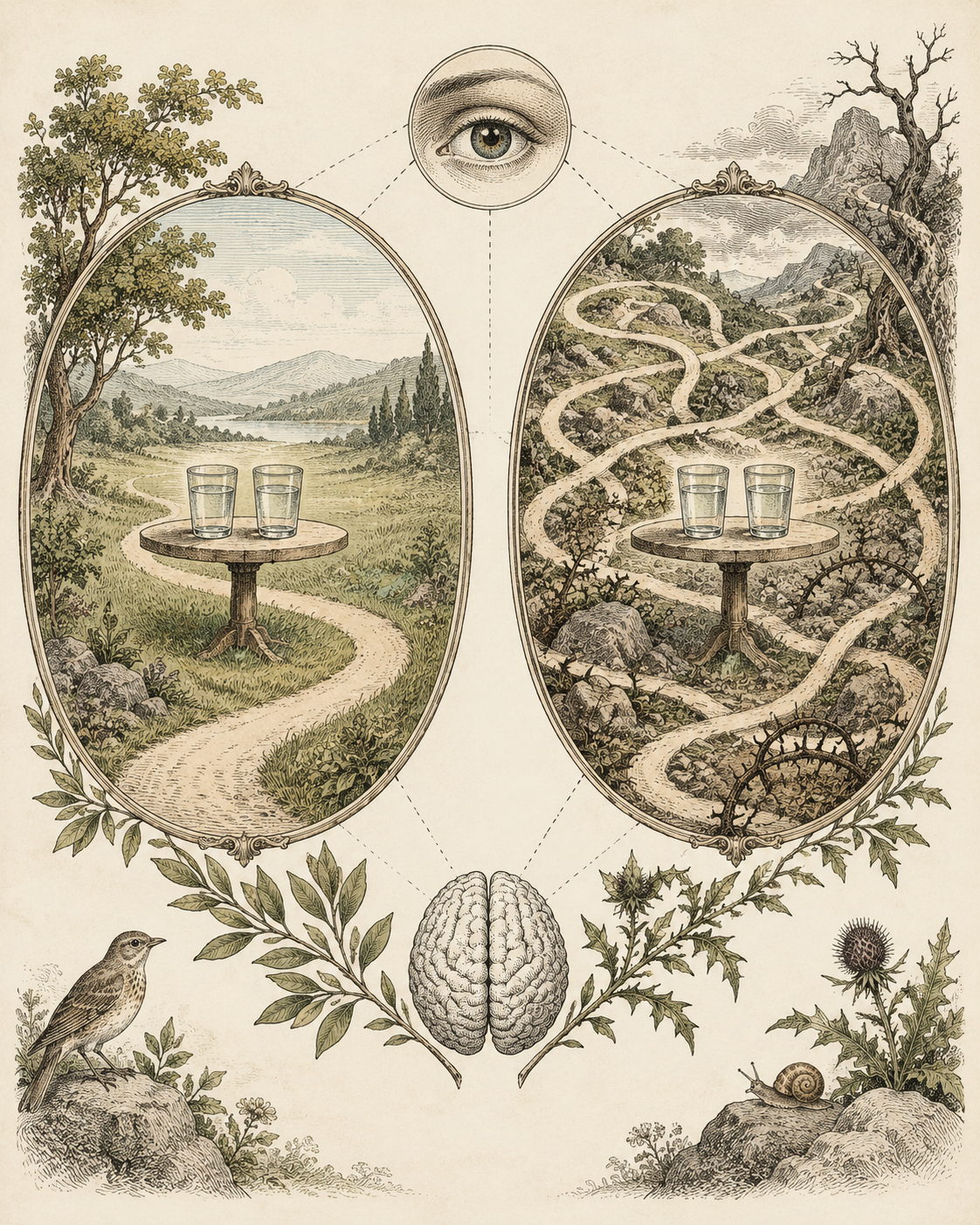
THE QUESTION IS NOT ONLY 'CAN I HAVE TWO?'
The Better Question Is What Happens to the Whole System When Alcohol Comes Back In
People often define moderation narrowly.
Can I stop at one or two?
That matters.
But it is not the whole experiment.
Suppose you can have two drinks at dinner.
What happens before dinner?
Are you thinking about the drinks all afternoon?
What happens the next night?
Does alcohol stay occasional, or does the negotiation return?
Do old rituals wake up?
Does Friday become important again?
Does one special occasion reopen weekday drinking?
Does sleep change?
Does your mental space change?
Moderation is not only a number inside the glass.
It is the relationship that forms around the number.
For some people, moderate drinking creates little friction.
For others, technically moderate consumption brings back a disproportionate amount of attention, bargaining and pattern creep.
Your evidence matters more than the word.

Why We Chose This For You
Loading your personalized notes…
YOU MAY WANT A CLEAR YES OR NO MORE THAN THE EVIDENCE CAN GIVE YOU
Ambiguity is uncomfortable.
A permanent rule can feel simpler.
So can a permanent permission.
But your evidence may be mixed.
Maybe you handled alcohol well in some situations and poorly in others.
Maybe the quantity was manageable but the mental preoccupation was not.
Maybe you still do not know.
That is a legitimate conclusion.
“I do not have enough evidence to make this easy yet” is more honest than forcing certainty because Day 90 is close.
CONTROL HAS MORE THAN ONE DIMENSION
Behavioral control is not only whether you can physically stop drinking.
It includes:
how much effort stopping requires,
whether limits remain stable,
how much anticipation builds,
whether alcohol reclaims old cues,
and how frequently the decision has to be renegotiated.
That is why two people with the same drink count can have very different relationships with alcohol.
The pattern around consumption matters.
WHY THIS MATTERS
Evaluating the broader behavioral pattern gives a more complete basis for personal decision-making than relying on quantity alone.

A Note For You
Loading your personalized notes…

Recent Slip Insight
Add a Title
ONE BENEFIT TO WATCH FOR

A More Honest Decision
You Can Evaluate Moderation Using the Whole Relationship, Not Only the Drink Count
That protects you from two easy mistakes.
Assuming moderation works because one night went fine.
Or assuming it can never work because the old pattern once became difficult.
You can look at the full evidence:
behavior,
mental load,
function,
aftermath,
autonomy.
Then make the decision that fits your actual life.
WHY THIS MATTERS
Evaluating the broader behavioral pattern gives a more complete basis for personal decision-making than relying on quantity alone.

WHAT PEOPLE DON'T TELL YOU
Curiosity does not create an obligation to test alcohol again.
You may wonder whether moderation would work.
That does not mean you owe yourself a trial.
Maybe your current life feels better enough that reintroducing alcohol has very little upside.
Maybe the uncertainty itself does not bother you.
You are allowed to decide:
“I do not need to know right now.”
A question can remain unanswered until answering it becomes useful.
ONE BENEFIT TO WATCH FOR


“The question is not what you can technically get away with. It is what relationship you want to maintain.”
Cheers Without Beers

Your Version of Today's Experiment
Loading your personalized notes…

What to Take Away
Add a Title

Today's Experiment
Write the Case for Both Sides
Using only your own history and the last eighty-five days, write the strongest evidence for moderation and the strongest evidence against it.


Build the Case For
What evidence suggests alcohol could occupy a small, low-friction place in your life? Use actual behavior, not preference.


Build the Case Against
What evidence suggests reintroducing alcohol may restart mental load, pattern creep, difficult functions or costs you no longer want?

WHAT DOES YOUR EVIDENCE SUPPORT?
Can you describe the tradeoffs clearly without forcing yourself into a permanent answer today?
A thoughtful 'not now' or 'I still don't know' can be a successful conclusion.


Write What You Still Do Not Know
Separate uncertainty from evidence. Do not fill gaps with optimism or fear.

20 Minutes

What to Watch For
Loading your personalized notes…
WANT TO GO DEEPER?
If You Ever Choose to Test Moderation
Make it an experiment, not a vague return.
If you ever decide to reintroduce alcohol, the useful approach is explicit.
Define what you are testing.
Define the limit.
Define the frequency.
Define which contexts are excluded.
Track mental preoccupation as well as quantity.
Track what happens the next day.
Set a review date.
Most importantly, define what evidence would cause you to stop the experiment.
That protects you from moving the goalposts after alcohol is already back in the system.
You do not need to make this plan today.
But if moderation is ever tested, clarity should come before the first drink—not after the pattern starts returning.
Evaluate the Whole Relationship
Do not reduce moderation to whether you can stop at two.
Look at quantity, frequency, mental load, function, context, aftermath and autonomy—and let your own evidence carry more weight than labels.


A Gentle Warning
Loading your personalized notes…
BEFORE YOU GO

What part of moderation feels most uncertain for you: quantity, frequency, mental load, old patterns returning, or whether you even want alcohol back?
There is no required answer today. Name the part you genuinely do not know.

THE DECISION FRAME
Moderation Is a Relationship Question, Not Only a Number Question
If alcohol returns, evaluate what happens around it—not only how many drinks are in the evening.

What Does “Alcohol-Free” Mean to You?
Tomorrow we remove the borrowed labels and decide what language, boundaries and identity actually fit your life.