.png)

Day 42 of 365
Your Best Stress Intervention
The goal is not to become great at 'coping with stress.' It is to learn what actually helps when your specific kind of stress shows up.

15
minutes
Deep Dive Optional
RESET SUPPORT

Yesterday You Named the State. Today We Match the Response.
Compare what you tried with what you needed. Even an unhelpful attempt can guide a better adjustment to your stress plan.
THE WRONG TOOL CAN MAKE GOOD ADVICE FEEL USELESS
A Hot Shower Is Great — Unless What You Actually Need Is to Send the Email
You have probably had this experience.
Someone gives you perfectly reasonable advice and you immediately hate it.
“Go relax.”
“Take a walk.”
“Try meditation.”
“Call somebody.”
“Get some sleep.”
Nothing is wrong with those ideas.
They are just answers without a question.
Imagine you are overwhelmed because twelve things are competing for your attention. A twenty-minute walk might help your body, but you may come back to the same twelve open loops.
Now imagine you are angry and replaying an argument. Sitting quietly with a notebook may turn into twenty minutes of writing a closing argument for a trial that is never happening.
Or maybe you are simply exhausted. You do not need a breakthrough. You need the evening to ask less of you.
Alcohol had one enormous advantage: it did not require much diagnosis. Same action, many states.
Your new system has to be smarter than that.
Not more complicated. Smarter.

Why We Chose This For You
Loading your personalized notes…
THE BEST TOOL MAY BE MUCH LESS IMPRESSIVE THAN YOU EXPECTED
Your best stress intervention may not be meditation.
It might be eating before you talk to anybody.
Turning your phone off for twenty minutes.
Taking one hard lap around the block.
Telling your family, “I need ten minutes before I can be useful.”
Finishing one annoying task instead of trying to relax while thinking about it.
That can feel almost too ordinary.
But ordinary is exactly what makes a tool usable.
The right intervention is the one that changes what happens next—not the one that sounds most enlightened when you describe it.
INTERVENTIONS WORK BETTER WHEN THEY TARGET THE FUNCTION
Stress is not one biological switch.
Different states can involve different combinations of arousal, fatigue, attention, uncertainty, frustration and social threat.
That means a strategy that helps one state can be neutral—or irritating—in another.
A calming technique may fit high arousal.
A problem-solving step may fit a concrete unresolved issue.
A reduction in stimulation may fit sensory overload.
Rest may fit depletion.
This is functional matching.
Instead of asking, “Is walking good for stress?” you ask, “When does walking change my behavior enough to matter?”
That is the level of information CWOB eventually needs to learn.
WHY THIS MATTERS
A well-matched intervention addresses the condition making alcohol appealing in that moment. That can reduce the need to fight the craving directly because part of what generated the craving has already changed.

A Note For You
Loading your personalized notes…

Recent Slip Insight
Add a Title
ONE BENEFIT TO WATCH FOR

Faster Recovery From the Right Problem
The Right Tool Can Shorten the Part of the Night Where Everything Feels Hard
When the intervention matches the state, you may notice something subtle: the problem stops spreading.
Overwhelm stays an overloaded schedule instead of becoming “my whole life is too much.”
Anger cools before it becomes an impulsive decision.
Exhaustion becomes a cue to reduce demands instead of a reason to chase fast relief.
The original problem may still exist.
But it takes up less of the evening.
WHY THIS MATTERS
A well-matched intervention addresses the condition making alcohol appealing in that moment. That can reduce the need to fight the craving directly because part of what generated the craving has already changed.

WHAT PEOPLE DON'T TELL YOU
Sometimes stress is telling you to rest. Sometimes it is telling you to act.
This is where generic “relaxation” advice can miss the point.
If you are anxious because you keep avoiding an important phone call, relaxation may make you feel better for ten minutes while leaving the source untouched.
If you are exhausted because you have been carrying too much, “take action” may be exactly the wrong message.
Some states need downshifting.
Some need movement.
Some need a boundary.
Some need one honest conversation.
Some need food and sleep.
Some need you to stop trying to solve them tonight.
The skill is not learning how to calm every feeling.
It is learning what the feeling is asking you to handle—and what can safely wait.
ONE BENEFIT TO WATCH FOR


“A coping tool gets better when it has a specific job.”
Cheers Without Beers

Your Version of Today's Experiment
Loading your personalized notes…

What to Take Away
Add a Title

Today's Experiment
Run a Stress-Match Test
Use one real stress moment today. Identify the state first, choose a matched intervention, then judge the response rather than the theory.


Name the State Before Choosing the Tool
Pick the closest label: overwhelm, anger, anxiety, exhaustion, frustration, overstimulation or your own. Rate it 0–10.


Choose for Function, Not Habit
Ask what the state needs most: less input, physical discharge, rest, one concrete action, connection, space or something else. Choose one intervention that matches.

WHAT ARE YOU TESTING?
Can you identify one stress state and one response that consistently belong together?
A useful result can be “this tool did almost nothing.” That tells us what not to keep prescribing.


Score What Changed
Afterward, rate the stress again. Also note alcohol urge, mental noise and whether you would realistically use this tool again in the same type of moment.

10–20 Minutes

What to Watch For
Loading your personalized notes…
WANT TO GO DEEPER?
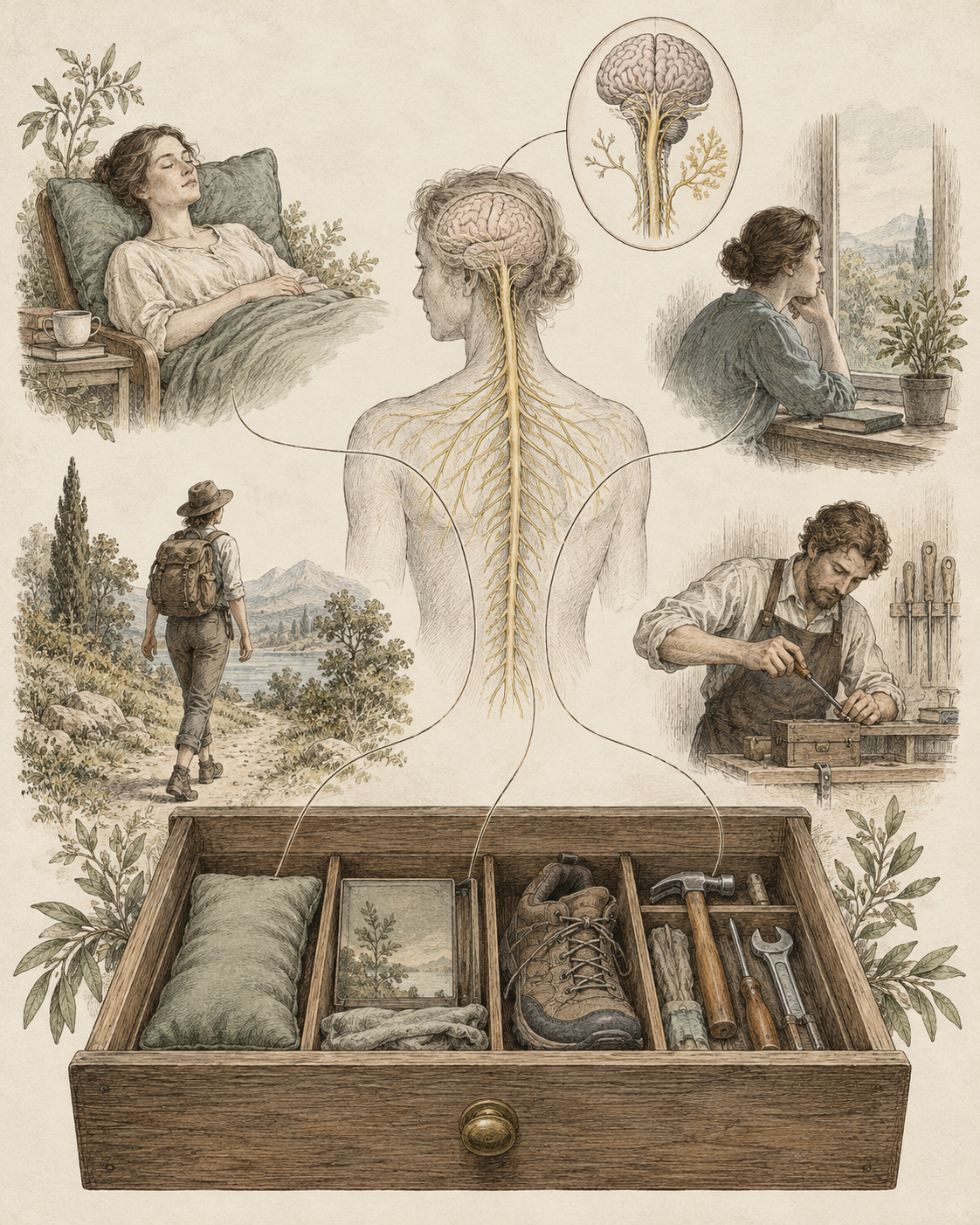
The Difference Between a Toolkit and a Junk Drawer
Having twenty coping skills is not the same as knowing when to use them.
A huge list of tools can create the illusion of support while leaving the hardest question unanswered:
Which one do I use now?
Personalization gets more valuable when it moves from preferences to outcomes.
Not:
“You said you like walking.”
But:
“Walking reduced anger-driven urges three different times, yet did almost nothing for exhaustion.”
Not:
“You selected mindfulness.”
But:
“Mindfulness helped with anticipatory anxiety at a 4 out of 10 and increased fixation during strong cravings.”
That is a fundamentally different system.
The goal is eventually to build a response map based on state, context and past response.
Person → situation → intervention → response → update.
Today is one small piece of that loop.
Match Before You Manage
The best stress tool depends on the stress.
Name the specific state, identify what it needs, test one matched response and keep the result.


A Gentle Warning
Loading your personalized notes…
BEFORE YOU GO

Which stress state seems to respond best to which intervention for you?
Write the state, what you tried, what changed and whether you would use the same response again.

ONE THING TO TAKE WITH YOU
Stop Asking One Tool to Do Six Jobs
Your stress plan gets stronger when overwhelm, anger, anxiety, exhaustion and overstimulation stop receiving the same response.

Loneliness vs. Solitude
Tomorrow we look at being alone—and whether alcohol was filling genuine disconnection or simply becoming part of your private time.