.png)
Day 40 of 365
Food, Hunger & Vulnerability
Sometimes the evening urge is emotional. Sometimes your body has been running on coffee, adrenaline and half a lunch.

15
minutes
Deep Dive Optional
RESET SUPPORT

Before You Analyze the Craving, Check Whether You Ate
An empty stomach can make an already difficult evening less manageable. Take care of the basics before asking yourself for a detailed explanation.
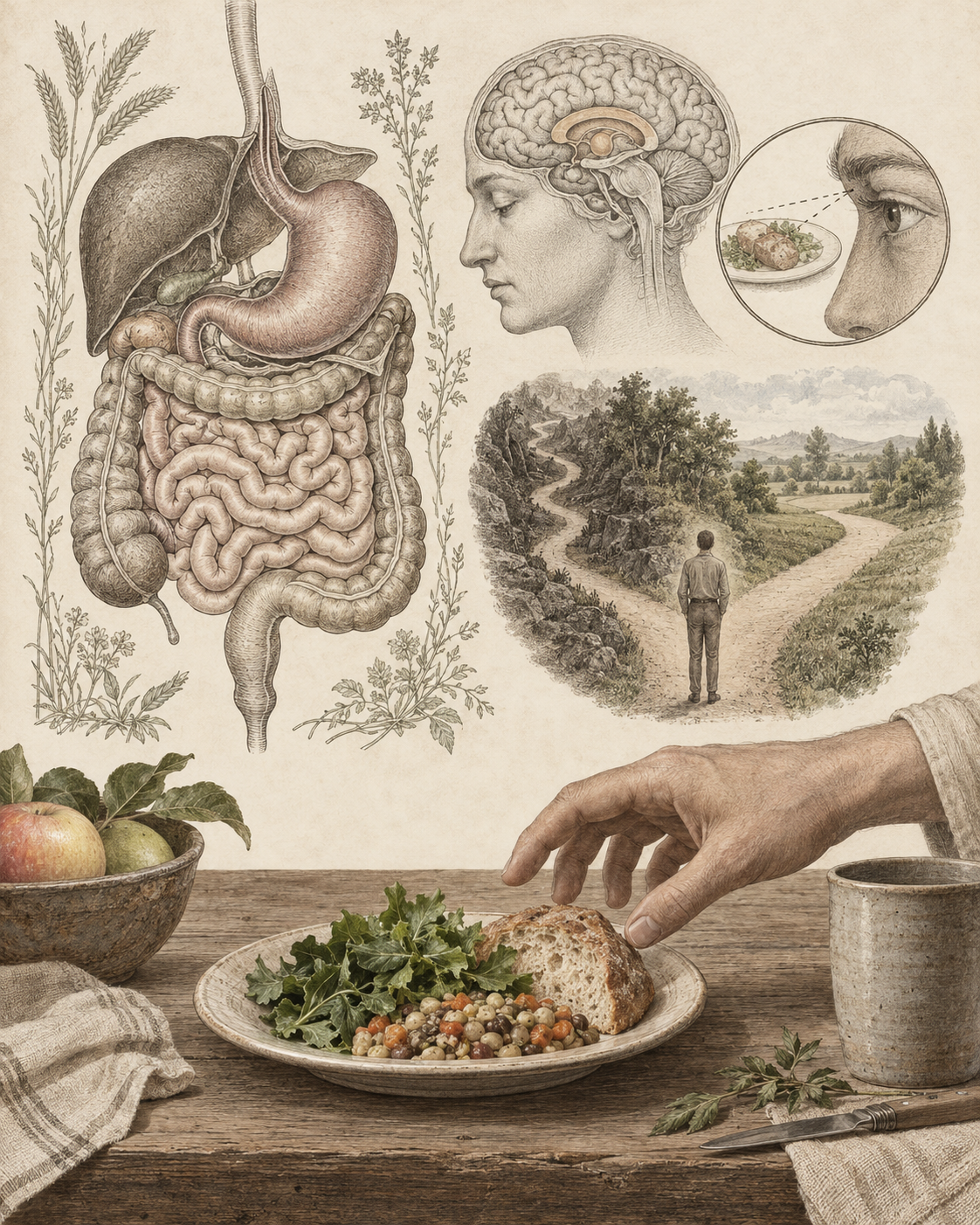
A LOT OF 'I NEED A DRINK' MOMENTS HAPPEN RIGHT BEFORE DINNER
The 5:30 PM Version of You May Be Solving Two Problems at Once
You leave work later than planned.
Lunch was small. Maybe it was barely lunch.
Traffic is annoying. You get home and somebody asks a question before you put your bag down.
Now everything feels louder.
You are impatient. Restless. A little shaky. Dinner still needs to happen.
And suddenly the drink idea feels perfect.
It promises quick reward, a marker that work is over, and a change in how the next twenty minutes feel.
It is tempting to label the entire moment “stress.”
Maybe stress is part of it.
But an underfed, depleted body can make everything else harder to carry.
The useful question is not whether hunger “causes” your craving.
It is whether hunger reliably lowers your margin enough that the old shortcut becomes much more attractive.

Why We Chose This For You
Loading your personalized notes…
YOU MAY DISCOVER THE CRAVING WAS REAL — AND HUNGER WAS TURNING UP THE VOLUME
Eating does not have to make the alcohol thought vanish for the experiment to matter.
Maybe you eat and still want a drink, but you stop feeling desperate about it.
Maybe the irritability drops.
Maybe the urgency drops.
Maybe the night feels less like an emergency.
That distinction is important.
The craving can be real while another body state is amplifying it.
You do not need to choose between “this is a habit” and “I was hungry.”
Both can be true at the same time.
LOW MARGIN MAKES IMMEDIATE REWARD MORE ATTRACTIVE
When you are hungry or physically depleted, patience and cognitive flexibility can be worse.
That does not mean hunger forces a person to drink. It means the decision is happening under different conditions.
Immediate reward may feel more valuable.
Small frustrations may feel bigger.
The effort required for a slower coping response may feel less worth it.
This is exactly why body-state data belongs in a behavioral program.
A craving is easier to understand when you know what condition the body was in when the craving arrived.
WHY THIS MATTERS
When basic physical needs are met before the high-risk window, you are less likely to ask a depleted body to perform its best decision-making under pressure.

A Note For You
Loading your personalized notes…

Recent Slip Insight
Add a Title
ONE BENEFIT TO WATCH FOR
More Physical Margin
A Fed Body May Give You More Room to Choose
If hunger is part of your pattern, eating earlier or more consistently can make the hard window feel less sharp.
You may notice steadier energy, less irritability and less urgency around immediate reward.
This will not solve every craving. It can remove one avoidable amplifier from the moment.
WHY THIS MATTERS
When basic physical needs are met before the high-risk window, you are less likely to ask a depleted body to perform its best decision-making under pressure.

WHAT PEOPLE DON'T TELL YOU
You do not need a flawless diet to learn whether hunger affects your drinking pattern.
This day can go sideways fast if it becomes:
“I need to meal prep perfectly.”
“I need ideal macros.”
“I need to lose weight too.”
“I should never snack.”
No.
We are answering one behavioral question.
Does being underfed make your alcohol pattern harder to manage?
If yes, create a practical buffer.
A real lunch.
A 4:30 snack.
Dinner started earlier.
Something available before the commute.
The solution should reduce strain, not add a second self-improvement program to your evening.
ONE BENEFIT TO WATCH FOR

“Before you call it a character problem, check whether your body has been asking for dinner for two hours.”
Cheers Without Beers

Your Version of Today's Experiment
Loading your personalized notes…

What to Take Away
Add a Title

Today's Experiment
Feed the Hard Window Before It Starts
On a day when you expect your usual evening urge, eat a normal meal or substantial snack before the peak window and compare what happens.


Find the Usual Window
Choose the time your evening urges usually begin. Write down when you last ate and how physically depleted you typically feel by then.


Eat Before the Peak
Have a normal meal or substantial snack before the usual hard window. Do not wait until the craving is already at full volume.

WHAT ARE YOU TESTING?
Does more stable eating reduce the intensity or urgency of your usual evening alcohol pattern?
If eating changes the hard window even modestly, you have found an upstream intervention worth remembering.


Compare the Quality of the Urge
Notice intensity, irritability, urgency, mental bargaining and energy. Ask what changed—not only whether the craving disappeared.

One Evening

What to Watch For
Loading your personalized notes…
WANT TO GO DEEPER?
Why 'Stress' Can Hide a Body-State Problem
Labels get less useful when they are too broad.
Suppose you repeatedly log “stress” at 6 PM.
That sounds emotional.
But zoom in.
You worked through lunch.
You have been awake since 5:30.
You had several caffeinated drinks.
Dinner is still thirty minutes away.
The house is loud.
Now a drink sounds incredibly appealing.
“Stress” is not wrong. It is incomplete.
A better model asks which conditions are stacking.
Hunger.
Fatigue.
Overstimulation.
Transition.
Reward expectation.
Maybe an actual work problem too.
Once you separate the stack, the intervention becomes more precise.
Food cannot solve a bad relationship or a brutal job. But a difficult conversation is harder when your body is running on fumes.
This is what pattern learning is for: finding the ordinary conditions that quietly make everything else harder.
Check the Body Before the Story
Some cravings are being amplified by a body that needs fuel.
Compare your eating schedule with your hard window. Then test whether eating earlier changes urgency, irritability or bargaining.


A Gentle Warning
Loading your personalized notes…
BEFORE YOU GO

What happens to your alcohol urges on days when you have eaten consistently versus days when you have not?
Think about timing, not perfect nutrition. Look for differences in urgency, irritability, energy and the speed at which the old routine starts.

ONE THING TO TAKE WITH YOU
A Craving Can Be Real and Still Be Amplified by Hunger
Meet the physical vulnerability early so you can see the rest of the pattern more clearly.

Stress Isn't One Thing
Tomorrow we stop using 'stress' as one giant category and separate overwhelm, anger, anxiety, exhaustion, frustration and overstimulation.