.png)

Day 39 of 365
Movement as a State Change
Sometimes the fastest way out of a stuck mental state is not another thought. It is moving the body that is carrying it.

15
minutes
Deep Dive Optional
RESET SUPPORT

This Is Not a Workout Day
A change of position or surroundings may help you settle. Keep it gentle; movement doesn't need to become punishment for the evening.
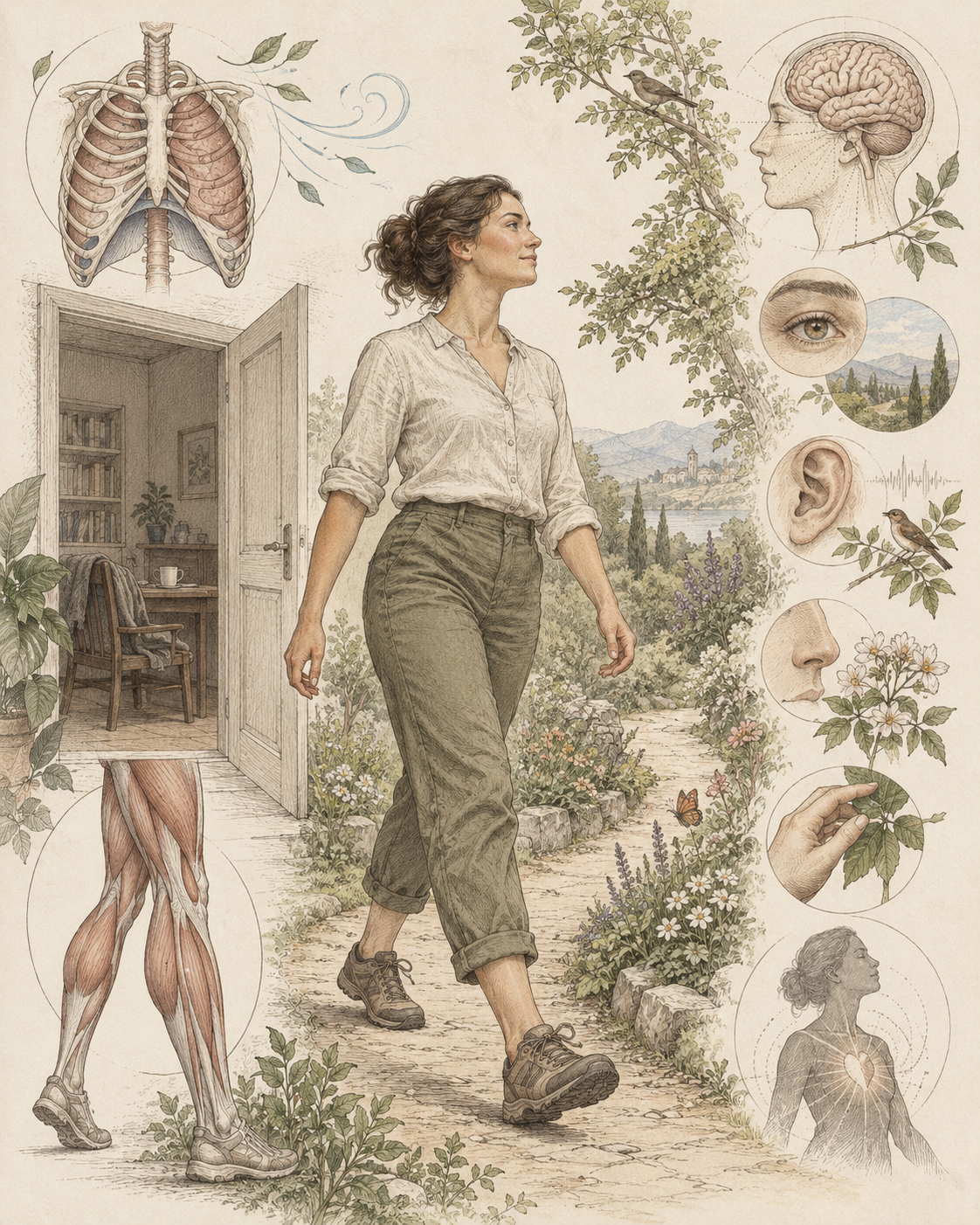
SOMETIMES YOUR MIND IS NOT THE BEST PLACE TO START
You Can Think About Changing States — Or Actually Change One
There are evenings when your thoughts are technically accurate and completely unhelpful.
“Yes, I’m stressed.”
“Yes, I know drinking won’t solve tomorrow.”
“Yes, I understand this is a habit.”
“Yes, I still want a drink.”
At some point, more thinking becomes another lap around the same track.
Then you put on shoes and walk around the block.
Nothing profound happens.
The problem still exists. The email is still annoying. The argument still happened.
But ten minutes later your body feels different. You are in a different place. Your breathing changed. Your attention moved outward. The exact rhythm of the old routine has been interrupted.
That shift may be small.
Small is enough to test.
Movement does not need to fix your life. It only needs to change the state enough that you have more options than you had five minutes ago.

Why We Chose This For You
Loading your personalized notes…
THE HARDEST PART MAY BE THE FIRST TWO MINUTES
When you are already depleted, movement can sound absurd.
You do not want to go for a walk.
You want the thing that promises immediate relief without requiring effort.
That is exactly why the starting threshold matters.
Your experiment can begin with “put shoes on and walk to the end of the street.” If you want to turn around, turn around.
You are not proving toughness.
You are seeing whether beginning movement changes the way the next choice feels.
Often the decision to move is harder than the movement itself.
MOVEMENT CHANGES MORE THAN FITNESS
Physical movement changes sensory input, breathing, posture, location, attention and often emotional intensity.
That makes it useful as a state-shifting tool even when the amount of exercise is too small to matter much for fitness.
A walk also does something behaviorally important: it makes the old routine temporarily harder to perform. You are no longer standing beside the cabinet, sitting in the old chair or driving past the store.
Movement combines internal change with environmental interruption.
That is why a ten-minute walk can sometimes outperform a complicated mental strategy—not because walking is magical, but because it changes several parts of the chain at once.
WHY THIS MATTERS
Movement can change attention, activation and environment at the same time, giving the old cue-response sequence less continuity.

A Note For You
Loading your personalized notes…

Recent Slip Insight
Add a Title
ONE BENEFIT TO WATCH FOR
State Flexibility
You Gain a Way to Change the Moment Without Needing the Moment to Cooperate
You cannot always think your way into a better mood.
Movement gives you another entry point.
Even a modest shift in physical state can make an urge feel less fused with the rest of the evening. You may still be stressed, angry or bored, but you are no longer experiencing it in exactly the same body position, place and rhythm.
WHY THIS MATTERS
Movement can change attention, activation and environment at the same time, giving the old cue-response sequence less continuity.

WHAT PEOPLE DON'T TELL YOU
You are not exercising because you had a craving.
Be careful with the story you attach to this tool.
“I wanted a drink, so now I have to run” can turn movement into punishment.
That is not what we are building.
The message is not:
“You were bad. Go burn it off.”
The message is:
“You are stuck in a state. Let’s see what happens if the body moves.”
That distinction matters. A tool you resent will not survive long enough to become useful.
ONE BENEFIT TO WATCH FOR


“You do not always need a better thought. Sometimes you need a different state.”
Cheers Without Beers

Your Version of Today's Experiment
Loading your personalized notes…

What to Take Away
Add a Title

Today's Experiment
Run a 10-Minute Movement Test
Choose one form of movement that matches your current state, then compare how the urge and your body feel before and after.


Name the State First
Before moving, choose the closest word: agitated, exhausted, bored, anxious, frustrated, restless, flat or something else. Rate the urge 0–10.


Match the Movement
Pick movement for the state—not for fitness. Brisk if you need discharge. Gentle if you need downshift. Novel if boredom is the problem. Outside if the environment itself feels stuck.

WHAT ARE YOU TESTING?
Which kind of movement changes your state enough to make the next decision easier?
The movement does not need to erase the urge. A meaningful shift in state is enough to make it useful.


Check What Actually Changed
After ten minutes, rate the urge again. Also note whether your mood, tension, attention or willingness to continue the old routine changed.

10–15 Minutes

What to Watch For
Loading your personalized notes…
WANT TO GO DEEPER?
Why Action Can Beat Analysis in the Right Moment
Some states are maintained by the setting, posture and action pattern around them.
Imagine trying to feel different while keeping every part of the old moment exactly the same.
Same chair.
Same room.
Same hour.
Same visual cues.
Same repetitive thoughts.
Same body position.
That is a difficult assignment.
Movement introduces new input. The visual field changes. Muscles engage. Breathing changes. Attention shifts. The person is physically unavailable for parts of the old routine.
This is one reason action-based interventions can be especially useful when the problem is looping, restlessness or a transition that never quite happened.
But fit still matters.
For someone who is severely exhausted, an intense workout may increase depletion. For someone who uses exercise compulsively, more exercise is not automatically a healthy recommendation.
The best version is proportional: enough movement to change state, not so much that the tool creates a new problem.
Move the State
Movement can interrupt the pattern without needing to solve the problem.
Name how you feel, choose movement that matches the state, and compare your urge and attention ten minutes later.


A Gentle Warning
Loading your personalized notes…
BEFORE YOU GO

What kind of movement changed your state most naturally today?
Describe more than the craving number. What happened to tension, restlessness, mood, attention and the feeling that alcohol was the obvious next move?

ONE THING TO TAKE WITH YOU
Movement Is a Lever, Not a Punishment
Use it when changing physical state makes more sense than having another argument inside your head.

Food, Hunger & Vulnerability
Tomorrow we look at something surprisingly practical: whether part of your evening craving is being amplified by an underfed, depleted body.