.png)

Day 37 of 365
The First 15 Minutes
You do not need to solve the whole night. You need a plan for the moment the old routine first wakes up.

15
minutes
Deep Dive Optional
RESET SUPPORT

Make the Window Smaller
Revisit the first few minutes, before things gathered speed. That may be the most useful place to put a different response next time.
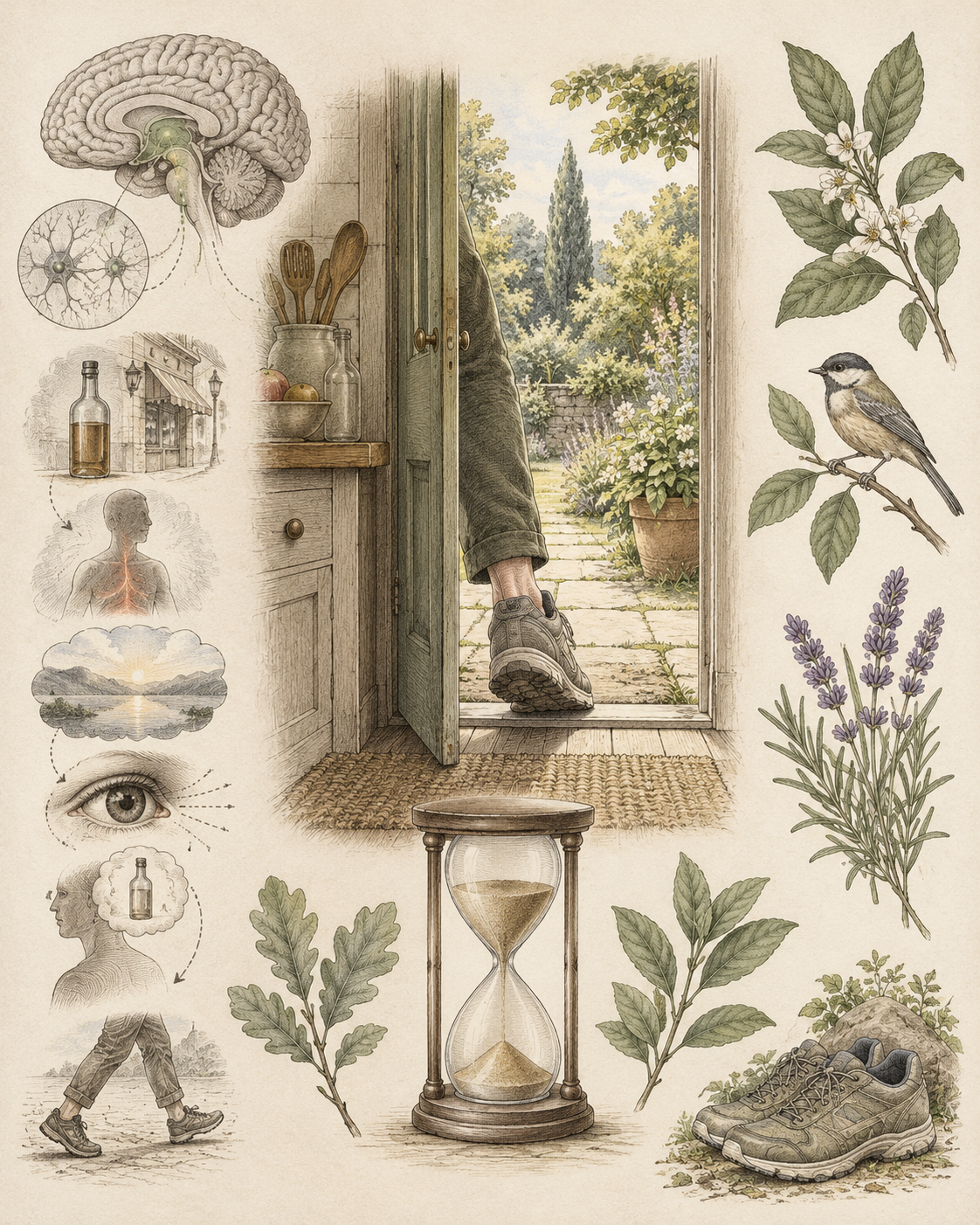
A CRAVING CAN WRITE THE WHOLE NIGHT IN ABOUT THIRTY SECONDS
At 6:12 PM, Your Brain Is Already Talking About 10:00 PM
Imagine a bad day ending exactly the way bad days tend to end.
You walk in already irritated. You are hungry. The kitchen looks familiar. Something about the time, the room or the end-of-day feeling lights up the old thought: a drink would take the edge off.
The thought itself might last two seconds.
Then the story starts.
“If I feel this way now, I’m going to feel this way all night.”
“I don’t have the energy to fight with myself for four hours.”
“I should just get it over with.”
Now you are not only dealing with a craving. You are dealing with a forecast.
But a lot can change in fifteen minutes. You eat. You move rooms. You shower. You get outside. You stop staring at the same cue. Somebody calls. Dinner starts. Your nervous system comes down half a notch.
None of those things guarantees the urge disappears. They do something more important first: they keep the opening minutes from making every decision at once.
That is the job today.

Why We Chose This For You
Loading your personalized notes…
THE URGENCY MAY STAY EVEN WHEN THE PLAN IS WORKING
This part is easy to misunderstand.
You can follow your first-15 plan and still feel uncomfortable.
You can walk outside and still want the drink.
You can eat dinner and still be irritated.
You can text someone and still think, “I would rather just have one.”
That does not mean the tool failed.
The first goal is not instant relief. The first goal is to interrupt automatic continuation.
Sometimes the emotional payoff comes later. Sometimes the craving stays annoying for a while. But now there is space between the first thought and the old behavior—and space is where choice starts showing up again.
URGES NARROW ATTENTION BEFORE THEY NARROW BEHAVIOR
When a familiar reward becomes important in the moment, attention can tighten around it.
You notice the bottle. The store. The hour. The imagined relief. The old option moves to the front of the mental queue while everything else feels less relevant.
That is one reason a small physical change can matter. Leaving the kitchen or stepping outside gives your attention different information.
A craving is rarely just one thought. It is a chain: cue, body state, expectation, attention, mental rehearsal, movement toward the behavior.
Interrupting any link can change what happens next.
You are not trying to prove that the urge is powerless. You are stopping the first burst of urgency from automatically completing the sequence.
WHY THIS MATTERS
Specific next steps reduce the need to invent a response while your attention is already narrowed. They also create time for your body state, surroundings and craving intensity to change before you reconsider anything.

A Note For You
Loading your personalized notes…

Recent Slip Insight
Add a Title
ONE BENEFIT TO WATCH FOR

A Smaller Hard Moment
The Night Stops Feeling Like One Giant Decision
When you reduce the assignment to the next fifteen minutes, the evening can feel less overwhelming.
Instead of asking, “Can I handle all of tonight?” you ask, “What do I do next?”
That can reduce the amount of bargaining wrapped around the urge. You may still feel it, but you are no longer asking one activated moment to predict the rest of your night.
WHY THIS MATTERS
Specific next steps reduce the need to invent a response while your attention is already narrowed. They also create time for your body state, surroundings and craving intensity to change before you reconsider anything.

WHAT PEOPLE DON'T TELL YOU
A successful fifteen minutes can still feel uncomfortable.
People often judge a coping tool by one question: “Did it make the craving go away?”
That is too narrow.
Maybe the walk did not erase the urge. But you did not stop at the store.
Maybe dinner did not fix your mood. But you stopped making decisions while hungry.
Maybe stepping outside did not make you happy. But it broke the exact sequence you usually follow.
A first-response plan is allowed to succeed before you feel good.
Sometimes the earliest win is simply this: the old pattern did not get to move as fast as it normally does.
ONE BENEFIT TO WATCH FOR


“Do not solve the whole night from the hardest five minutes.”
Cheers Without Beers

Your Version of Today's Experiment
Loading your personalized notes…

What to Take Away
Add a Title

Today's Experiment
Build Your First-15 Protocol
Create a three-step response for your most common hard window, then rehearse it once before you actually need it.


Choose the Exact Moment
Use yesterday’s environment audit and your trigger hierarchy. Pick one real opening moment: walking in after work, beginning dinner, sitting down after the kids go to bed, passing the store, or whatever repeatedly starts the chain.


Choose Three Moves
Pick one physical change, one vulnerability response and one delay statement. Keep them realistic enough that you would still do them on a terrible day.

WHAT ARE YOU TESTING?
Can you make your first response specific enough that you do not need to invent it during the craving?
Success is not zero craving. Success is knowing what you do before the old sequence takes over.


Rehearse It Before the Craving
Run through the sequence once while calm. Put the shoes where you need them. Prepare the snack. Save the text. Make the first move easier to start than the old one.

15 Minutes

What to Watch For
Loading your personalized notes…
WANT TO GO DEEPER?
Why Delay Can Change the Decision
Urgency compresses time. A protocol gives time back.
Strong urges often carry a feeling of immediacy: decide now, act now, fix this now.
That feeling can be more influential than the absolute intensity of the craving.
A short delay changes the conditions under which the next decision is made. The cue may be less visible. Hunger may be lower. Your body may have moved. The anticipated reward may no longer have your full attention.
This does not mean every urge fades neatly like a wave on a chart. Real cravings can be messy. Some spike twice. Some hang around. Some disappear after dinner. Some keep returning.
The practical value of delay is simpler: you stop making the permanent-looking decision from the most activated version of the moment.
Fifteen minutes is not a magic number. It is a manageable container. Long enough for something to change. Short enough that your brain is less likely to reject the plan before you start.
Shrink the Window
The first urge does not get to make the whole-night decision.
Name the urge, change something physical, address the obvious vulnerability and delay the alcohol decision for fifteen minutes.


A Gentle Warning
Loading your personalized notes…
BEFORE YOU GO

What exactly happens in the first fifteen minutes of your most common hard window?
Start with the cue. Then write the first thought, the first physical move and the point where the old sequence usually becomes harder to interrupt.

ONE THING TO TAKE WITH YOU
You Only Need the Next Move
A hard evening gets smaller when you stop asking the first craving to predict the entire night. Build the opening response first.

Urge Surfing — Does It Work for You?
Tomorrow you will test a mindfulness-based way of observing a craving—and, just as importantly, decide whether it actually fits you.