.png)

Day 34 of 365
The Transition Problem
Some of the strongest drinking cues live in the space between one part of the day and the next. Today you map the transitions where your brain expects alcohol to mark the change.

15
minutes
Deep Dive Optional
RESET SUPPORT

If the Hard Part Is Not the Event but the Switch
The switch between work and home may need more space. After a rough transition, try giving tomorrow a clearer pause between the two.
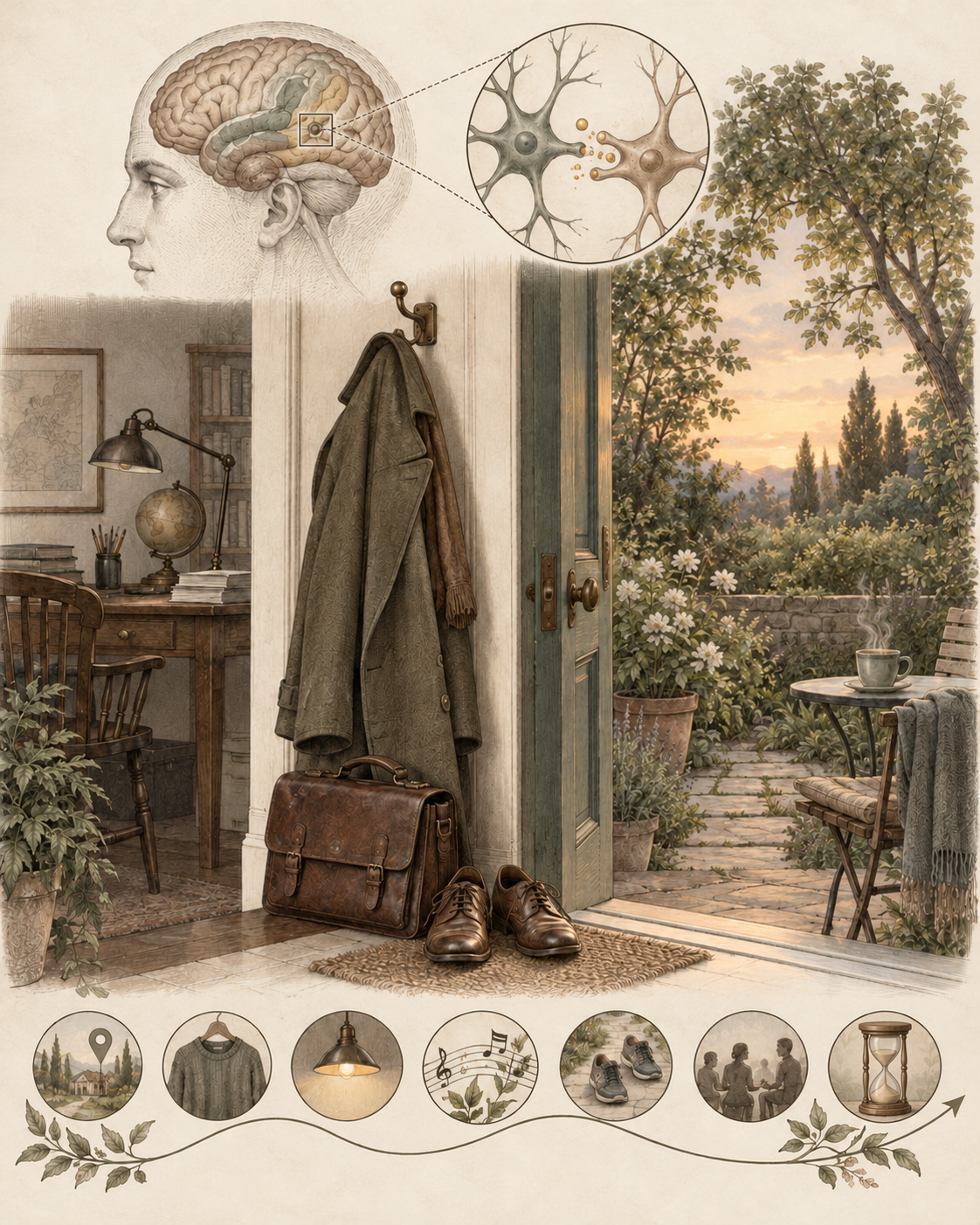
THE OLD DRINK MAY HAVE BEEN A PUNCTUATION MARK
What Told Your Brain, “That Part Is Over”?
A drink can do more than change how you feel. It can mark a boundary.
Work is over. The kids are finally settled. The weekend has started. The guests left. The game is on. You are off duty now.
When the drink disappears, the boundary can disappear with it. The day becomes one long sentence. You are technically home but still mentally at work. Dinner is finished but the evening has not quite started. Everyone else is asleep and you have not found the signal that says, “Now I get to be me.”
That uncomfortable in-between feeling is not always a craving for alcohol itself. Sometimes it is a craving for a clear transition.

Why We Chose This For You
Loading your personalized notes…
THE EMPTY 20 MINUTES CAN FEEL WEIRDER THAN THE WHOLE EVENING
The strange part is that you may be perfectly fine once the evening gets going. The discomfort is concentrated in the handoff.
That can make the whole night feel harder than it actually is. If the first twenty minutes are loaded, your brain may predict three hours of struggle.
Notice the difference. You may not need an elaborate evening plan. You may need a reliable ten-minute bridge that carries you across the exact point where the old sequence used to start.
CONTEXT CHANGES HELP THE BRAIN SHIFT STATES
Brains use context to organize behavior: location, clothing, light, music, movement, people, and time all help signal what happens next. When the same cue sequence repeatedly marks “work is over” or “the weekend begins,” the sequence can become a behavioral boundary.
Alcohol can occupy that boundary because it is fast, sensory, and repeatable. But it does not own the function.
A new sequence can become meaningful through repetition too. The goal is not to trick the brain with a fake substitute. It is to give the transition a consistent cue that does the job you actually need: closure, permission, decompression, or a shift in role.
WHY THIS MATTERS
Clear boundaries can reduce the urge to use alcohol as punctuation. When the transition has its own beginning and end, the drink no longer has to be the only reliable marker that tells your brain the role has changed.

A Note For You
Loading your personalized notes…

Recent Slip Insight
Add a Title
ONE BENEFIT TO WATCH FOR
Separation
The Evening Can Start More Cleanly
A deliberate transition can reduce the sense that work, parenting, chores, or stress are bleeding endlessly into the night. The goal is not to manufacture excitement. It is to help your body and attention recognize, “That part is over; this part has started,” without requiring alcohol to create the boundary.
WHY THIS MATTERS
Clear boundaries can reduce the urge to use alcohol as punctuation. When the transition has its own beginning and end, the drink no longer has to be the only reliable marker that tells your brain the role has changed.

WHAT PEOPLE DON'T TELL YOU
If 5:30 feels unfinished without alcohol, the missing piece may be a transition ritual.
It is easy to assume, “I miss having a drink after work.” Sometimes what you miss is more specific: the moment you stopped being responsible to the workday.
That distinction matters. If the drink was functioning as a doorway, replacing only the liquid can leave the doorway missing. You can be holding a sparkling water and still feel like work never ended.
Build the boundary on purpose. The most useful replacement may be ten minutes that changes clothes, location, sound, pace, and expectations—not a beverage that tries to impersonate the old one.
ONE BENEFIT TO WATCH FOR


“Sometimes you do not miss the drink. You miss the moment it used to create.”
Cheers Without Beers

Your Version of Today's Experiment
Loading your personalized notes…

What to Take Away
Add a Title

Today's Experiment
Build One Transition Ritual
Replace one alcohol-linked handoff with a short, repeatable sequence that clearly marks the change.


Choose the Loaded Transition
Pick one: work to home, dinner to evening, kids to bedtime, weekday to weekend, social to alone, or another recurring handoff.


Name the Old Job
What did the drink signal here—relief, permission, reward, energy change, separation, connection or silence?

WHAT ARE YOU TESTING?
Can you make the transition feel distinct enough that alcohol is no longer the only reliable marker?
If the new ritual made the boundary feel even 10% clearer, keep testing it.


Build a 10-Minute Bridge
Create a sequence of two or three actions that begins immediately at the transition and ends in the next part of your evening.

10–20 Minutes

What to Watch For
Loading your personalized notes…
WANT TO GO DEEPER?
Why Thresholds Become Strong Habit Cues
The moment between routines can become a routine of its own.
Habits are often embedded in sequences. The end of one behavior becomes the cue for the next. “Close laptop” predicts “walk to kitchen.” “Start cooking” predicts “pour drink.” “Kids go to bed” predicts “finally exhale.”
Because the sequence is chained, changing only the final action can leave the earlier cues firing exactly as before.
A transition ritual works by inserting a new sequence at the boundary itself. Repetition matters more than novelty. The bridge should be simple enough that you can use it on an ordinary Tuesday, not just when you are highly motivated. Over time, the new sequence can become the thing that tells your brain what the drink used to say: that part is over.
Build the Bridge
Do not leave the handoff empty.
Pick one loaded transition, name what alcohol used to signal, and build a ten-minute replacement ritual.


A Gentle Warning
Loading your personalized notes…
BEFORE YOU GO

Which transition in your day feels most incomplete without the old drinking ritual?
Think in boundaries: what are you leaving, and what are you entering?

ONE THING TO TAKE WITH YOU
Transitions Need a Replacement, Not Just Resistance
When alcohol marked the end of one role and the beginning of another, removing it leaves a gap. Give the gap a new ritual.

Decision Fatigue
Tomorrow we reduce the number of times you have to “decide not to drink” by changing defaults before your energy runs low.