.png)

Day 3 of 365
Why Does the First Drink Work So Fast?
The first drink can feel like a switch: shoulders drop, conversation gets easier, the workday feels over, or the noise in your head turns down. That effect is real enough to teach the brain a powerful lesson.

10
minutes
Deep Dive Optional
RESET SUPPORT

Something Went Sideways?
The relief you wanted was real, even if the result disappointed you. Consider another way to meet that need tonight.
THE FIRST SHIFT
There Was a Reason You Reached for It
Think about the first few minutes after a drink you really wanted. Maybe your shoulders loosened. Maybe you stopped replaying the day. Maybe conversation suddenly felt easier. Maybe the room did not change at all, but your relationship to the room did.
That shift matters. If something changes your state quickly and predictably, the brain pays attention. It starts connecting the situation before the drink with the relief, reward or confidence that follows. Over time, the promise can become almost as important as the effect itself.
There is no value in pretending the first drink never did anything for you. If it had no payoff, it would be much easier to ignore. Today we are naming the payoff clearly enough to understand why the pattern became compelling in the first place.

Why We Chose This For You
Loading your personalized notes…
THE FIRST DRINK MAY HAVE KEPT ITS PROMISE
Maybe your shoulders dropped, conversation got easier or the workday finally felt over. Admitting that alcohol worked briefly is not endorsing it; it is being honest about why the pattern became convincing.
UNDER THE HOOD
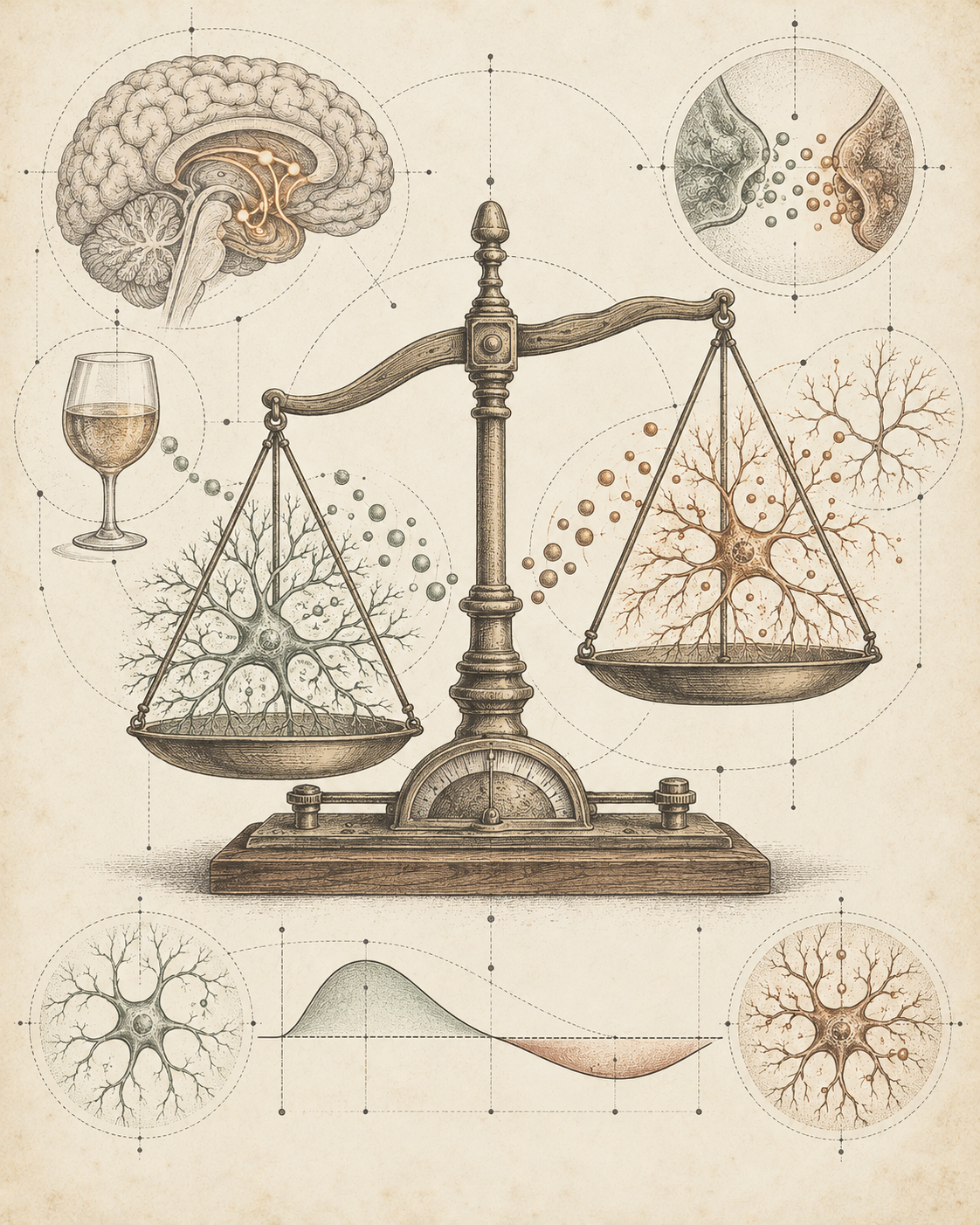
Alcohol affects several signaling systems in the brain. Among them are GABA and glutamate, which help regulate inhibition and excitation, along with reward pathways that influence learning and motivation. Early in a drinking episode, those changes can feel like less restraint, less tension or more ease.
As alcohol is cleared, the nervous system does not simply stay in that first relaxed state. The body is constantly trying to maintain balance, and the later phase can feel quite different from the opening one. For some people that shows up as restlessness, lighter sleep, irritability or next-day unease.
The useful point is the shape of the curve: the experience at minute twenty is not the whole experience.
Why Naming the Payoff Changes Things
“I wanted a drink” is hard to work with because it sounds like the drink itself was the need. “I wanted my brain to quiet down” is much more specific. So is “I wanted to feel social,” “I wanted a reward,” or “I wanted the day to be over.”
Specific needs create options. Quiet might come from a shower, music, a walk or ten minutes alone. Social ease might come from arriving with one person you trust. Reward might need something genuinely enjoyable, not another task disguised as self-care.
You are not searching for a perfect substitute today. You are separating the desired state from the product that has been delivering it.

A Note For You
Loading your personalized notes…

Recent Slip Insight
Add a Title
ONE BENEFIT TO WATCH FOR
Relief
The Exhale Makes Sense
What you gain here is a clearer read on the payoff. Naming the exact change you wanted makes the urge easier to understand and easier to answer.
Why Naming the Payoff Changes Things
“I wanted a drink” is hard to work with because it sounds like the drink itself was the need. “I wanted my brain to quiet down” is much more specific. So is “I wanted to feel social,” “I wanted a reward,” or “I wanted the day to be over.”
Specific needs create options. Quiet might come from a shower, music, a walk or ten minutes alone. Social ease might come from arriving with one person you trust. Reward might need something genuinely enjoyable, not another task disguised as self-care.
You are not searching for a perfect substitute today. You are separating the desired state from the product that has been delivering it.

WHAT PEOPLE DON'T TELL YOU
Relief is real—and it can still be expensive.
The first effect and the later cost can both be true. Holding both is more useful than pretending the drink never helped.
ONE BENEFIT TO WATCH FOR


“The brain learns fastest from what changes the moment quickly.”
YOUR RESET

Your Version of Today's Experiment
Loading your personalized notes…

What to Take Away
Add a Title

Today's Experiment
Map the First-Drink Promise
Write the promise of the first drink: “After the first drink, I expect to feel…” Then list what tends to arrive later.


Remember
Think of a recent first drink and the moment just before it.


Name the Payoff
Name what you expected it to give you: relief, fun, confidence, connection, reward, quiet or something else.

Name the Promise and the Price
See the whole sequence: quick payoff, fading effect and the part that shows up after the buzz.
You separated the promise from the full result. That is useful leverage.


Check the Other Side
Notice what happened later that night or the next morning—not as punishment, just the rest of the data.

5–10 Minutes

What to Watch For
Loading your personalized notes…
WANT TO GO DEEPER?
The Relief-and-Rebound Story
The first effect can be real without being the full cost-benefit picture.
Expectation can amplify what happens after a drink. If a certain glass, bar, song or time of day already means “relax now,” part of the shift can begin before much alcohol has reached the brain. That does not mean the effect is imaginary; it means chemistry and learned expectation can work together.
This is one reason the first drink can feel especially efficient. It arrives on top of anticipation. Later drinks may add alcohol without reproducing the same clean sense of transition.
Pay attention to that distinction. What are you actually chasing: the pharmacological effect, the permission to stop working, the ceremony, the social signal, or the first ten minutes of change? The answer may be a mix. The more precise you get, the easier it becomes to build alternatives that compete with the right part of the experience.
The Fast Payoff Teaches the Brain
The relief was not imaginary.
Alcohol can create a fast state change. The brain learns that speed even when the later experience is less helpful.


A Gentle Warning
Loading your personalized notes…
BEFORE YOU GO

What did you most expect the first drink to change?
Name it plainly: quieter, looser, happier, less responsible, more social, numb—or something else.

ONE THING TO TAKE WITH YOU
Relief Makes More Sense When You See the Whole Curve
Understanding the payoff is not making excuses. It shows what a replacement must address.

Your Drinking Loop — Cue → Drink → Relief → Repeat
Tomorrow we stop looking at alcohol as a single decision and start looking at the sequence around it: the cue, the drink, the payoff, and the repetition that can make the whole thing feel automatic.