.png)

Day 26 of 365
Build Your Personal Toolkit
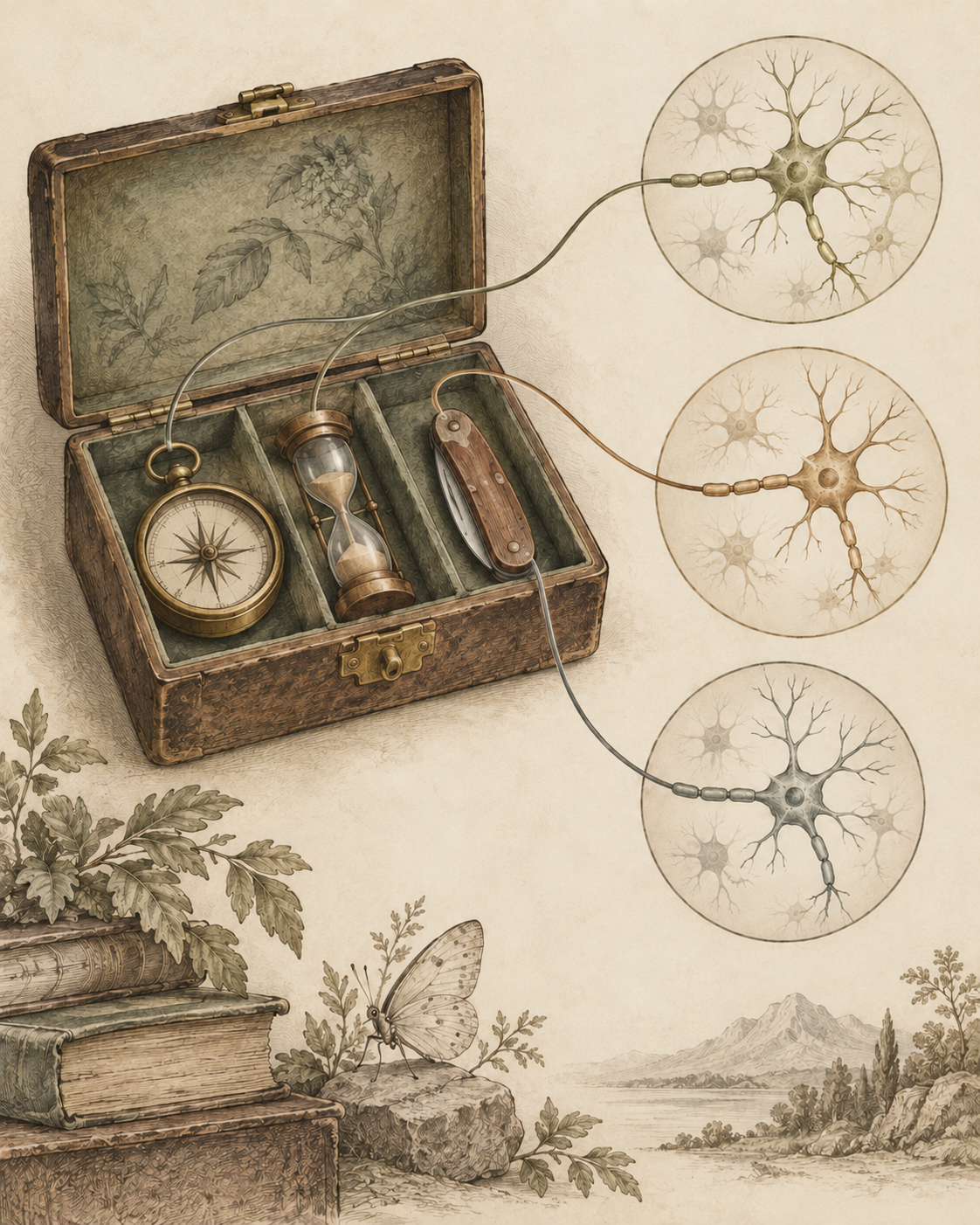
You have tested enough ideas to stop collecting advice. Today you keep the 5–7 tools that actually helped you—and match each one to the moment it is built for.

15
minutes
Deep Dive Optional
RESET SUPPORT

If Your Toolkit Failed in a Hard Moment
A tool that didn't help isn't the only tool available. Try a simpler option, or ask someone to help you think it through.
GENERIC ADVICE ENDS HERE
Your Best Tools Have Already Left Clues
You do not need thirty coping strategies.
You need a short list you can remember when it is 7:12 PM, you are tired, you have not eaten enough, and your brain is suddenly very interested in the old routine.
Look back over this month.
Maybe food fixed more than you expected. Maybe a ten-minute walk broke the after-work loop. Maybe calling somebody helped when the problem was loneliness. Maybe leaving a party early worked better than “being strong.” Maybe a replacement drink was useful in restaurants and useless at home.
Some things earned their spot.
Some things sounded intelligent and did absolutely nothing.
Today, results get promoted.

Why We Chose This For You
Loading your personalized notes…
THE BEST TOOL MAY LOOK RIDICULOUSLY SIMPLE
Some of your best tools may feel embarrassingly ordinary.
Eat a sandwich.
Go home.
Take a shower.
Put shoes on and walk.
Text one person.
Go to bed.
People often underrate simple responses because they do not sound psychologically sophisticated.
But if hunger, habit, and a long day are driving the moment, a sandwich plus a change of location may beat the most beautiful journal prompt ever written.
Usefulness wins.
REPETITION TURNS A TOOL INTO A DEFAULT
The old drinking sequence has repetition on its side.
You have practiced it in certain contexts enough times that the response can feel fast and available.
New responses need repetitions too.
Each time a particular cue is followed by a different action that actually helps, that alternative becomes easier to retrieve next time.
You are not deleting a pathway. You are building competition.
That is why a small toolkit used repeatedly is often more powerful than a giant list you never remember under pressure.
WHY THIS MATTERS
Fewer good choices can be more useful than endless options.
The first-line tool does not have to solve the whole night. It only needs to make the next ten minutes easier enough that you can choose again.

A Note For You
Loading your personalized notes…

Recent Slip Insight
Add a Title
ONE BENEFIT TO WATCH FOR

Response Speed
You Know What to Try First
A small set of proven responses gives you a first move.
That matters because decision-making gets worse when you are tired, stressed, hungry, emotional, or already negotiating.
You do not need to invent a plan from scratch every time the cue appears.
WHY THIS MATTERS
Fewer good choices can be more useful than endless options.
The first-line tool does not have to solve the whole night. It only needs to make the next ten minutes easier enough that you can choose again.

WHAT PEOPLE DON'T TELL YOU
Label the tool by the problem it actually solves.
Do not write “walk” in your toolkit.
Write: “When I get home wired and irritated, I walk for ten minutes before I sit down.”
Do not write “call someone.”
Write: “When I start feeling isolated on the weekend, I text Josh before 7 PM.”
Specific tools are easier to retrieve because the cue is already attached to the response.
ONE BENEFIT TO WATCH FOR


“Your toolkit is not what should work. It is what has worked.”
Cheers Without Beers

Your Version of Today's Experiment
Loading your personalized notes…

What to Take Away
Add a Title

Today's Experiment
Build Your 5–7
Use your month as the evidence base. Promote only tools that helped, or that you have a strong reason to test again.


List the Moments
Write your most common situations: stress, reward, ritual, boredom, social pressure, loneliness, craving or whatever showed up for you.


Name the Winners
Beside each moment, list what actually helped. Circle the tools that worked more than once or worked especially well.

WHAT ARE YOU TESTING?
Can you turn a month of experiments into a small, usable response system?
If you leave today with five to seven tools you can name without opening the app, you have enough. A toolkit is useful when it is retrievable.


Create Your First-Line Five
Choose 5–7 tools. Give each one a job and a trigger: “When X happens, I try Y first.”

10–20 Minutes

What to Watch For
Loading your personalized notes…
WANT TO GO DEEPER?
Why Specific Plans Beat Vague Intentions
A toolkit works best when the cue and response are connected.
Vague intentions force your future self to do too much work.
“I will make a better choice” means you still have to identify the problem, generate options, compare them, and act while the old routine is already pulling.
A cue-response plan removes some of that load.
“If I get home fried and start thinking about a drink, I eat first and go outside for ten minutes.”
“If I am at dinner and rounds keep coming, I order my second NA drink before the table orders again.”
“If I am angry after an argument, I do not make an alcohol decision until I have had twenty minutes alone.”
The plan should be specific enough to use and flexible enough to update.
Your toolkit is a living document. It earns revisions through evidence.
Keep 5–7 Tools You Trust
Build for the hard moment, not the perfect morning.
Match each tool to a specific job. Put the best-tested response first.


A Gentle Warning
Loading your personalized notes…
BEFORE YOU GO

Which tool from this Reset surprised you by working better than you expected?
Name the situation, what you tried and what changed afterward.

ONE THING TO TAKE WITH YOU
Your Toolkit Should Fit Your Life
Keep the responses that earned their place. Retire the ones that did not. Add new ones only when they solve a real problem.

Know Your High-Risk Moments
Tomorrow we map the moments most likely to catch you off guard—time, place, people, emotion, body state and thought—and attach a response before they happen.