.png)
Day 22 of 365
The Weekend Problem
Sometimes Friday is the trigger. The challenge is not making the weekend less special—it is teaching your brain a different way to recognize that it has arrived.

15
minutes
Deep Dive Optional
RESET SUPPORT

If Friday or Saturday Hit Harder Than You Expected
Weekends can bring a different set of pressures. Pick the part of the remaining evening you can influence, rather than writing off the whole weekend.
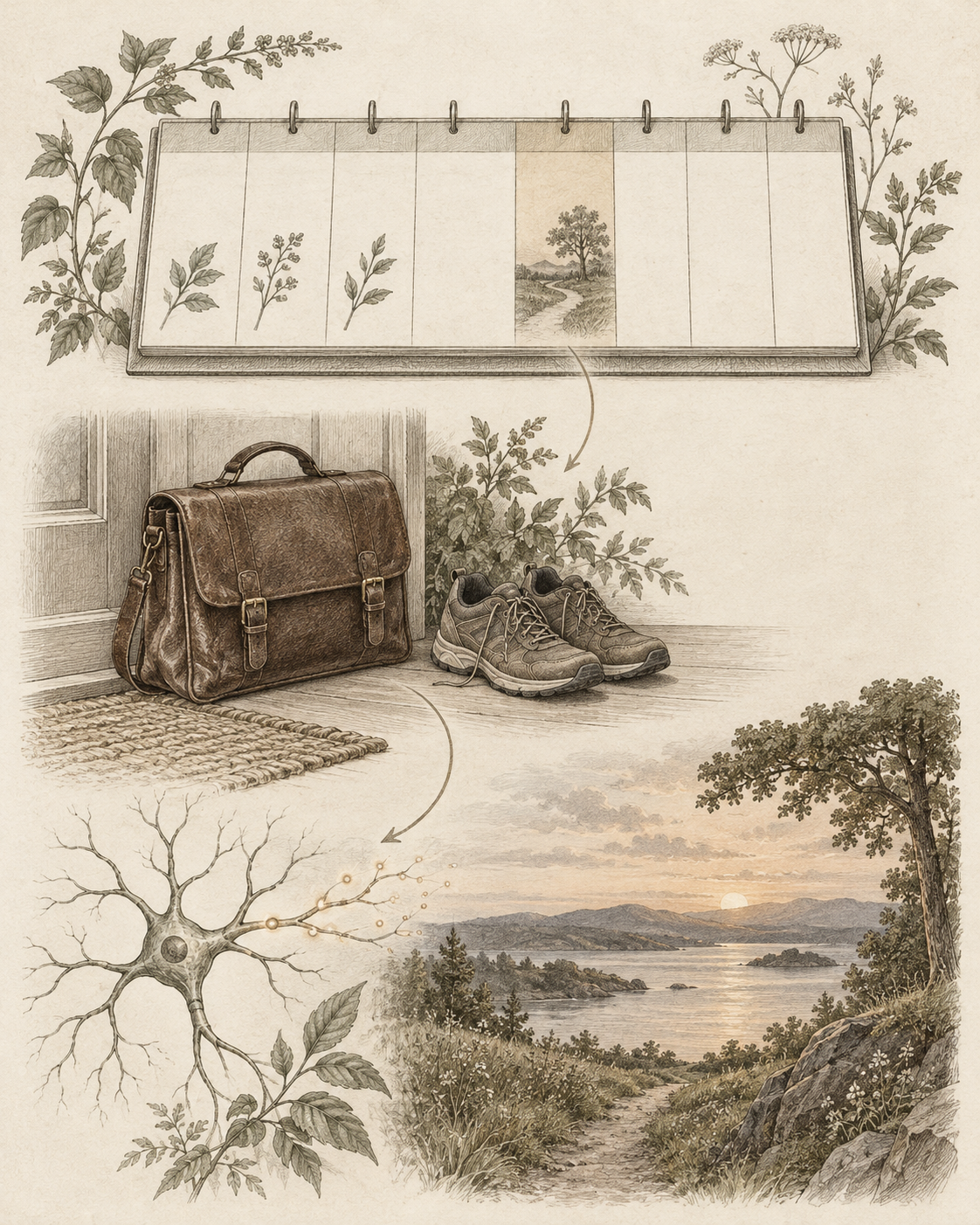
FRIDAY CAN ARRIVE BEFORE THE CRAVING DOES
Sometimes the Trigger Is the Day of the Week
Tuesday can be completely fine.
Then Friday hits 4:30 PM and something changes.
Nothing terrible happened. You are not suddenly more anxious. The calendar just flipped into the part of the week that used to come with a familiar reward.
Maybe Friday meant the first pour while dinner cooked. Saturday meant the game, the patio, friends over, no alarm tomorrow. The drink was part of the signal that responsibility was over.
Remove it, and the weekend can briefly feel like somebody forgot to start the weekend.
That is useful information.
You may not be missing alcohol as much as you are missing contrast: work is done, this night is different, I get to loosen up now.

Why We Chose This For You
Loading your personalized notes…
THE EMPTY HOUR MAY BE THE HARDEST PART
The hardest hour may be the handoff.
Laptop closes. Kids settle down. Sun goes lower. Friends start texting. The game comes on. Your brain knows what used to come next.
That hour can feel flat in a way that makes alcohol seem unusually attractive.
Try not to interpret the flatness as a verdict.
It may simply be an old prediction reaching the point where the reward used to arrive. Give that hour something else to begin anticipating.
TIME AND CONTEXT CAN BECOME CUES
Habits are tied to context.
When a time, place, sequence, or social setting is repeatedly paired with reward, the context itself can begin producing expectation.
That is why a Friday urge can show up before you have consciously decided anything.
The cue has years of repetitions behind it.
New weekend routines work through the same learning process in the other direction. Repeatedly pair Friday evening with a different transition and the old prediction slowly loses its monopoly.
WHY THIS MATTERS
A pattern is easier to sustain when the new version of the weekend has something to offer.
If Saturday morning starts becoming valuable, Friday night decisions also begin carrying a different cost and a different reward.

A Note For You
Loading your personalized notes…

Recent Slip Insight
Add a Title
ONE BENEFIT TO WATCH FOR

Weekend Freedom
Friday Stops Owning the Script
When you design the weekend on purpose, you get the contrast without automatically giving alcohol the job of creating it.
That means Friday can still feel like Friday.
You are not flattening the week. You are widening the number of ways the week can change gears.
WHY THIS MATTERS
A pattern is easier to sustain when the new version of the weekend has something to offer.
If Saturday morning starts becoming valuable, Friday night decisions also begin carrying a different cost and a different reward.

WHAT PEOPLE DON'T TELL YOU
Friday night and Saturday morning are one decision system.
The old plan may have treated them like separate worlds.
Tonight was tonight. Tomorrow would deal with itself.
Try pairing them instead.
What do you want to enjoy tonight, and what do you want to be available for tomorrow?
You do not have to choose the most productive Saturday morning imaginable. Just give tomorrow enough value that tonight is no longer the only part of the weekend that counts.
ONE BENEFIT TO WATCH FOR

“The weekend still gets to feel like the weekend.”
Cheers Without Beers

Your Version of Today's Experiment
Loading your personalized notes…

What to Take Away
Add a Title

Today's Experiment
Redesign the Weekend Transition
Build a Friday or Saturday sequence that keeps anticipation and reward while changing the automatic next step.


Find Your Weekend Starting Gun
What exact moment used to signal drinking could begin? Time, place, person, activity or thought.


Build a Replacement Marker
Create one event that clearly says “workweek over”: special meal, workout, music, NA ritual if helpful, outing, movie, sauna, dessert, game or friend.

WHAT YOU ARE TESTING
Can you make the weekend feel rewarding without making alcohol the event that creates the reward?
If the weekend felt even slightly more intentional and less like something was missing, keep the part that worked. We are building a new weekend script one repetition at a time.


Give Tomorrow Something to Protect
Schedule one Saturday-morning thing you genuinely want—not a punishment workout unless you actually enjoy it.

10–20 Minutes

What to Watch For
Loading your personalized notes…
WANT TO GO DEEPER?
Why Weekends Can Feel Disproportionately Hard
Anticipation can be learned long before the first drink.
The brain is predictive.
If hundreds of Fridays followed the same sequence, “Friday at five” can carry its own internal expectation. That expectation may feel like craving, restlessness, or a vague sense that something is missing.
The most effective response is not necessarily pretending Friday is ordinary.
Make it special in a new way.
Pick a transition cue. Pick one reward. Protect one thing about the next morning. Repeat the combination often enough that the weekend begins acquiring a second script.
One sober Friday may feel like deprivation. Five different but genuinely enjoyable Fridays begin to become evidence.
Change the Weekend Cue
Do not make Friday feel like Tuesday with better self-control.
Keep the contrast. Change what the contrast points toward.


A Gentle Warning
Loading your personalized notes…
BEFORE YOU GO

What makes Friday or Saturday feel meaningfully different to you besides alcohol?
Think in terms of anticipation, freedom, food, people, place, pace and what tomorrow allows.

ONE THING TO TAKE WITH YOU
The Calendar Can Be a Cue
A weekend urge is not proof that you secretly need alcohol. It may be a deeply rehearsed expectation—and expectations can be retrained.

Identity — “Am I Someone Who Doesn’t Drink?”
Tomorrow we go deeper than triggers and rituals into identity: what happens when drinking has been part of how you describe yourself—or how other people know you.