.png)

Day 19 of 365
Replacement Drinks: Helpful or Triggering?
An NA beer can be a perfect bridge for one person and a terrible idea for another. Today we stop arguing about which camp is right and test what happens to you.

15
minutes
Deep Dive Optional
RESET SUPPORT

If the Replacement Made You Want the Real Thing
Pay attention to how a replacement drink actually felt. If it made things harder, you're allowed to try a completely different evening ritual.
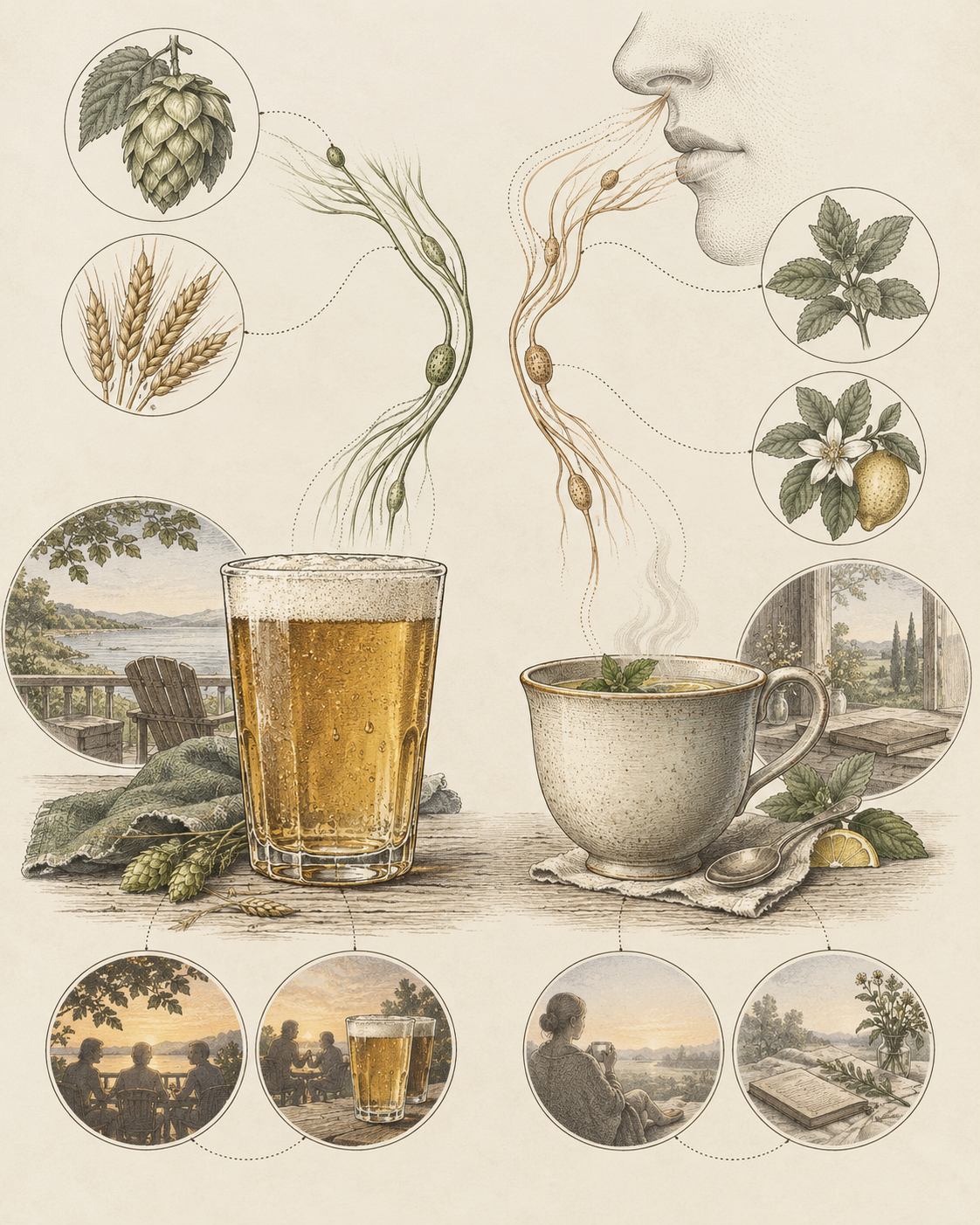
THE SAME GLASS CAN MEAN TWO DIFFERENT THINGS
A Replacement Can Calm the Ritual—or Keep It Alive
Two people can crack open the exact same alcohol-free beer at 6 PM and have opposite nights.
For one person, it solves the problem beautifully. Cold can. Familiar taste. Something to hold while grilling. The ritual gets what it wanted, and ten minutes later they are thinking about dinner.
For the other person, the first sip opens the old file. Now they are thinking about the real version. They notice what is missing. They start negotiating. “Would one actually matter?”
Same product. Same alcohol content. Completely different effect on the pattern.
That is why “Are NA drinks good?” is too simple a question.
The useful question is: what happens in you after you use one?

Why We Chose This For You
Loading your personalized notes…
YOU MAY LOVE THEM, HATE THEM OR FEEL ABSOLUTELY NOTHING
You may love them. You may think they are pointless. You may like them only in restaurants. You may find one brand calming and another weirdly activating.
All of those are valid outcomes.
This is not a purity test. You are not “more alcohol-free” because you drink plain seltzer, and you are not doing the Reset wrong because an NA beer makes a cookout easier.
We are testing function, not ideology.
SIMILAR CUES CAN EITHER SATISFY OR PRIME THE OLD EXPECTATION
Cues are learned through your own history.
For one person, the taste of beer may mostly signal “cold drink on the patio.” For another, it may strongly predict intoxication, another round, or a specific emotional release.
That means a similar-tasting substitute can either satisfy part of the routine or amplify attention to what is absent.
The label on the bottle cannot tell you which response you will have. Your before-and-after experience can.
WHY THIS MATTERS
Not every habit needs to be demolished.
Sometimes the useful move is to separate the sensory ritual from the chemical effect. But the ritual only earns a place if it lowers friction rather than keeping you mentally parked next to alcohol.

A Note For You
Loading your personalized notes…

Recent Slip Insight
Add a Title
ONE BENEFIT TO WATCH FOR
Ritual Flexibility
You May Be Able to Keep the Ceremony Without the Consequence
For the right person, a replacement drink lets you keep the part of the moment you actually liked: the cold glass, bitterness, garnish, opening ritual, toast, or transition.
If that is enough, you can preserve the ceremony without taking on the part that used to affect sleep, mornings, control, or how the night ended.
WHY THIS MATTERS
Not every habit needs to be demolished.
Sometimes the useful move is to separate the sensory ritual from the chemical effect. But the ritual only earns a place if it lowers friction rather than keeping you mentally parked next to alcohol.

WHAT PEOPLE DON'T TELL YOU
If the substitute makes you spend the whole night thinking about alcohol, it is not doing the job.
A beautiful zero-proof cocktail can still be a bad tool for you.
Likewise, an NA beer can be a perfectly good tool if it makes the cookout feel normal and then disappears from your mind.
There is no moral hierarchy here. Plain water does not win points. Realistic imitation does not win points. The winner is whichever option lets you move on with your evening.
ONE BENEFIT TO WATCH FOR


“A good tool makes the next decision easier.”
Cheers Without Beers

Your Version of Today's Experiment
Loading your personalized notes…

What to Take Away
Add a Title

Today's Experiment
Run the Replacement Test
If replacement drinks are appropriate for you, today is a controlled test. If you already know they are unhelpful or you avoid them for personal reasons, test a deliberately different ritual instead.


Measure Before
Before the replacement, rate your interest in alcohol from 0–10. Also note what you want from the drink: taste, ritual, social camouflage, reward, something cold, something adult-feeling, or simply variety.


Use One Replacement Deliberately
Choose one option and drink it in the context where alcohol would normally appear. Do not keep swapping products looking for the perfect one. The point is to observe your response, not conduct a tasting festival.

WHAT YOU ARE TESTING
Does similarity to the old ritual reduce friction for you—or wake the old expectation back up?
The test worked if you know more than you did before. Keep the replacement if alcohol got quieter. Change course if it got louder.


Measure After
Thirty minutes later, rate your interest in alcohol again. Then finish: 'This made the old pattern feel quieter / unchanged / louder because…'
If you are not using drink-style substitutes, compare a completely different ritual instead.

30–45 Minutes

What to Watch For
Loading your personalized notes…
WANT TO GO DEEPER?
Context May Matter More Than the Product
Home, restaurants and parties can produce different answers.
Context may matter more than the product.
An NA beer might be useful at a ball game because it removes the feeling that your hands and routine are “different.” The same drink at home may feel like rehearsing an old pattern you would rather let fade.
A mocktail might be fun on a date because it gives the night some ceremony. Making one alone every Tuesday may feel forced.
That kind of context-specific answer is exactly what we want.
“Helpful socially, unnecessary at home.”
“Fine with food, not when I am stressed.”
“Good at a cookout, bad after a hard workday.”
Those are smart conclusions. Your toolkit does not need universal rules. It needs accurate ones.
Ask What They Do to You
Do not ask whether replacement drinks are good. Ask what they do to you.
Use your own before-and-after response. If a substitute makes alcohol quieter, it may be useful. If it makes alcohol louder, choose a different ritual.


A Gentle Warning
Loading your personalized notes…
BEFORE YOU GO

When you use a drink that resembles alcohol, do you feel satisfied, neutral, teased—or something else entirely?
Think about the thirty minutes after the drink, not just whether the first sip tasted good.

ONE THING TO TAKE WITH YOU
The Best Replacement Is the One That Reduces Friction
You do not need an NA version of everything, and you do not need to avoid them on principle. Keep the tools that make your next choice easier and retire the ones that keep you mentally circling alcohol.

Confidence Without Alcohol
Tomorrow we look at something people often credit to alcohol: confidence. Did the drink create it—or simply turn down the part of your brain that was watching you?