.png)
Day 18 of 365
The Social Test
You do not need to prove you can handle every room. Today is about learning what actually happens when alcohol is present and you make your own decision.

15
minutes
Deep Dive Optional
RESET SUPPORT

If the Social Moment Got Away From You
A social plan that didn't hold needs adjusting, not defending. Think about the point where a little backup would have helped.
THE MOMENT EVERYONE ORDERS
Social Drinking Is Often About More Than the Drink
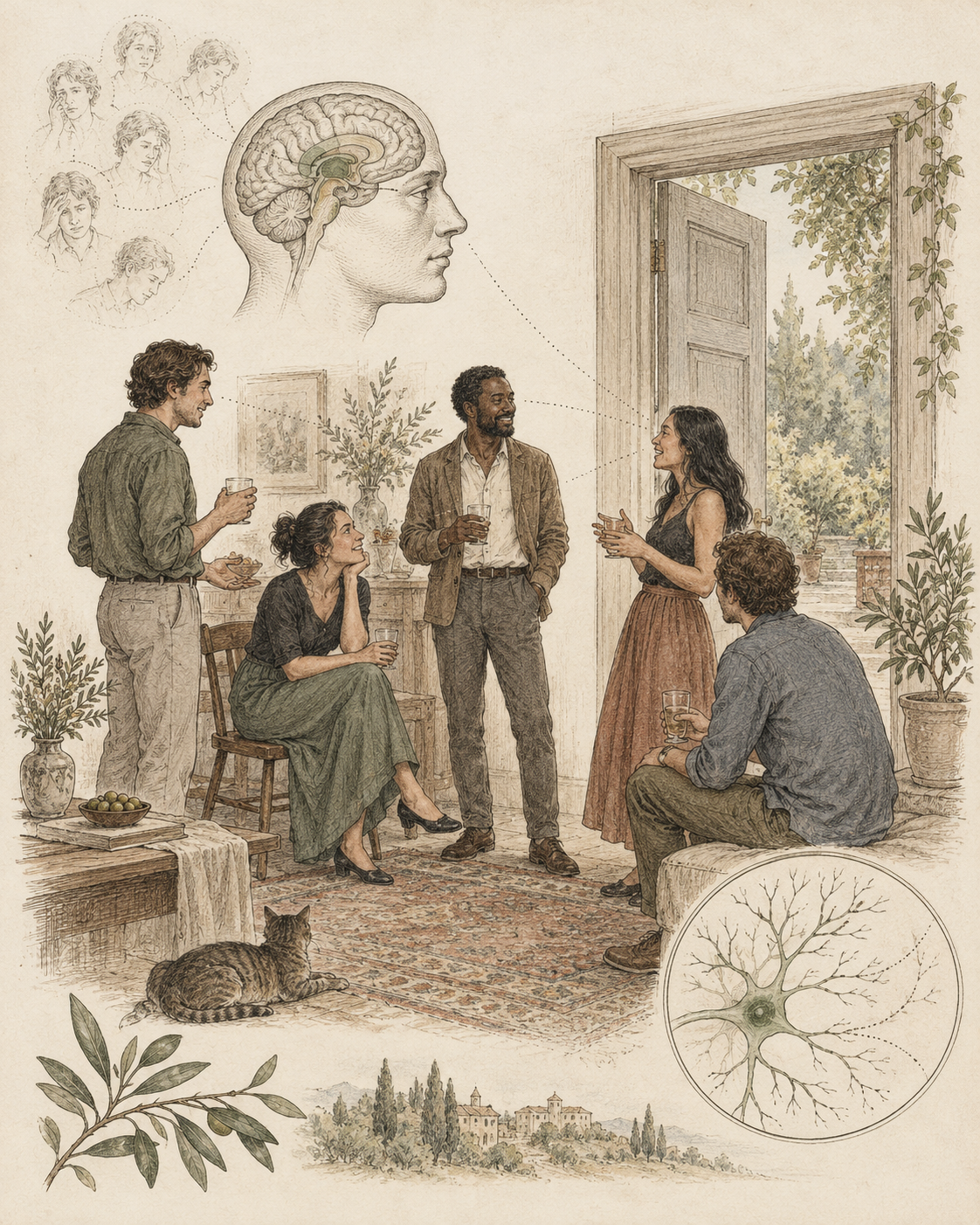
The server starts around the table.
Beer. Margarita. Bourbon. Wine.
Then it is your turn.
The whole moment lasts maybe fifteen seconds, but it can feel absurdly large when you are doing something different from the usual script. What do I order? Do I explain? Is somebody going to ask? Am I making this weird? Am I going to look boring?
Then you order.
And most of the time, the room keeps moving.
This is worth noticing because social drinking is often made up of tiny pressure points, not one giant test. Arriving. Ordering. The toast. The second round. The point when everybody gets louder. The moment you realize you are ready to go home.
When you break the night into those pieces, it becomes much easier to design.

Why We Chose This For You
Loading your personalized notes…
THE FIRST 20 MINUTES MAY BE THE STRANGEST
The first twenty minutes may be the weirdest part.
You arrive. You are figuring out where to stand. Your hands suddenly feel like they need an assignment. Small talk seems louder. You notice who is drinking and what everybody ordered.
Then food arrives. Someone tells a story. The game starts. You stop thinking about your hands.
That shift is easy to miss if you leave the night believing the initial awkwardness was the whole event. Sometimes it was just the doorway.
ALCOHOL CAN LOWER SELF-MONITORING—BUT THAT IS NOT THE SAME AS CREATING SOCIAL SKILL
Alcohol can reduce self-monitoring. You may notice less of the internal commentary that asks, “How am I coming across? Was that stupid? Should I say this?”
That reduction can feel like confidence, but it is not the same thing as social skill.
Listening, asking questions, telling stories, noticing humor, making eye contact, tolerating a pause, leaving when you are done: those are behaviors you can practice while fully present.
The more often you do that, the less the room has to feel like a performance you need chemistry to enter.
WHY THIS MATTERS
Reassurance helps a little. Lived evidence helps more.
Every time you handle one small social moment, the next similar moment becomes less unknown. Confidence is built from those repetitions.

A Note For You
Loading your personalized notes…

Recent Slip Insight
Add a Title
ONE BENEFIT TO WATCH FOR

Social Evidence
You Can Replace Prediction With Experience
One ordinary social experience can shrink a huge future fear.
Before a Reset, it is easy to imagine every wedding, vacation, dinner, concert, game, and holiday through one question: “How would I ever do that without drinking?”
Then you do one normal thing. You order. Somebody asks once. The night goes on.
That does not prove every event will be easy. It gives your brain a real memory to use instead of only a prediction.
WHY THIS MATTERS
Reassurance helps a little. Lived evidence helps more.
Every time you handle one small social moment, the next similar moment becomes less unknown. Confidence is built from those repetitions.

WHAT PEOPLE DON'T TELL YOU
Leaving at 10:15 can be a better decision than proving you can stay until 1:30.
The event may change as the night goes on.
The dinner you enjoyed turns into rounds. The conversation gets repetitive. People get louder. You get tired. The part you came for is over.
Going home is not automatically avoidance. Sometimes it is just accurate.
You do not earn extra credit for spending two miserable hours in a room you no longer want to be in.
ONE BENEFIT TO WATCH FOR


“You are allowed to participate without performing.”
Cheers Without Beers

Your Version of Today's Experiment
Loading your personalized notes…

What to Take Away
Add a Title

Today's Experiment
Run a Real-World Social Test
If you have a social event today, use this plan in real time. If you do not, rehearse it with the next realistic event on your calendar.


Decide Before You Arrive
Choose your first drink, your simple answer if someone asks, and your earliest acceptable exit time.
Example: 'Diet Coke with lime.' 'I'm taking a break right now.' 'If I want to leave after dinner, I can.'
Pre-deciding removes three small negotiations from the room.


Find the Hardest Five Minutes
During or after the event, identify the specific five-minute stretch that felt hardest. Was it arrival, ordering, a toast, someone pushing, a lull in conversation, or the point when others got noticeably drunker?

WHAT YOU ARE TESTING
Which part of socializing actually needs a strategy—and which part was mostly fear of the unknown?
Compare what you predicted with what actually happened. Even if the night was hard, identifying the exact hard part gives you something far more useful than “socializing without alcohol is difficult.”


Score the Prediction
Before the event, rate how difficult you expect it to be from 0–10. Afterward, rate what actually happened.
Do not grade yourself. Compare prediction with reality. That gap is valuable data.

Before + After One Social Situation

What to Watch For
Loading your personalized notes…
WANT TO GO DEEPER?
Avoidance and Exposure Both Have a Place
The right move depends on the person and the moment.
Both avoidance and exposure can be smart. The trick is matching them to the situation.
A low-pressure dinner with people who support you can be useful practice. You get to learn that ordering differently does not change who you are with them.
A party built almost entirely around heavy drinking may teach you very little except that being around heavy drinking is hard right now.
Think in levels. Easy social settings help you collect confidence. Moderate ones let you practice planning and boundaries. High-risk ones may be worth postponing until your new routine is steadier.
Courage is not measured by choosing the hardest possible room.
Prepare for the Small Moments
Make the social problem smaller.
Choose your drink, your one-line answer and your exit option before you arrive. Then notice the exact part of the event that was genuinely difficult.


A Gentle Warning
Loading your personalized notes…
BEFORE YOU GO

Which social moment do you worry about most without alcohol—and what actually happened the last time you faced something similar?
Separate what you predicted from what occurred. They are often not identical.

ONE THING TO TAKE WITH YOU
You Do Not Have to Prove Anything in the Room
A successful social night can mean staying, leaving, talking, being quiet, ordering an NA beer, ordering water or deciding the event is not worth it. The goal is choice—not performance.

Replacement Drinks: Helpful or Triggering?
Tomorrow we take a nuanced look at NA beer, mocktails and other replacements. For some people they are perfect. For others they keep the old loop louder than it needs to be.