top of page
.png)

Day 104 of 365
Caffeine & Stimulation
The question is not whether stimulation is good or bad. It is whether you are using it intentionally—or constantly trying to override your state.

15
minutes
Deep Dive Optional
DAY 104

Notice How Often You Press the Gas
Feeling wound up can make settling down harder. Review the whole day's stimulation before deciding that you simply handled the evening badly.
YOU MAY BE TRYING TO FEEL AWAKE ALL DAY AND CALM ON COMMAND AT NIGHT
The Nervous System Does Not Always Appreciate the Schedule
Think about a normal day.
Caffeine early.
Maybe more caffeine later.
Notifications.
Meetings.
Music.
Podcasts in the car.
Phone while eating.
Phone while using the bathroom.
Television while scrolling.
Then bed.
There may be almost no low-input space.
Then we ask:
Why can I not switch my brain off?
Sometimes the answer is not a lack of relaxation technique.
It is that the day barely practiced being unstimulated.

Why We Chose This For You
Loading your personalized notes…
LESS STIMULATION CAN FEEL BORING BEFORE IT FEELS CALM
This matters.
If your baseline has been constant input, quiet can initially feel flat.
You reach for the phone without thinking.
Turn something on.
Grab another drink.
Find another task.
That does not necessarily mean you hate quiet.
It may mean your brain is used to frequent novelty.
Give it a few minutes before deciding the silence is unbearable.
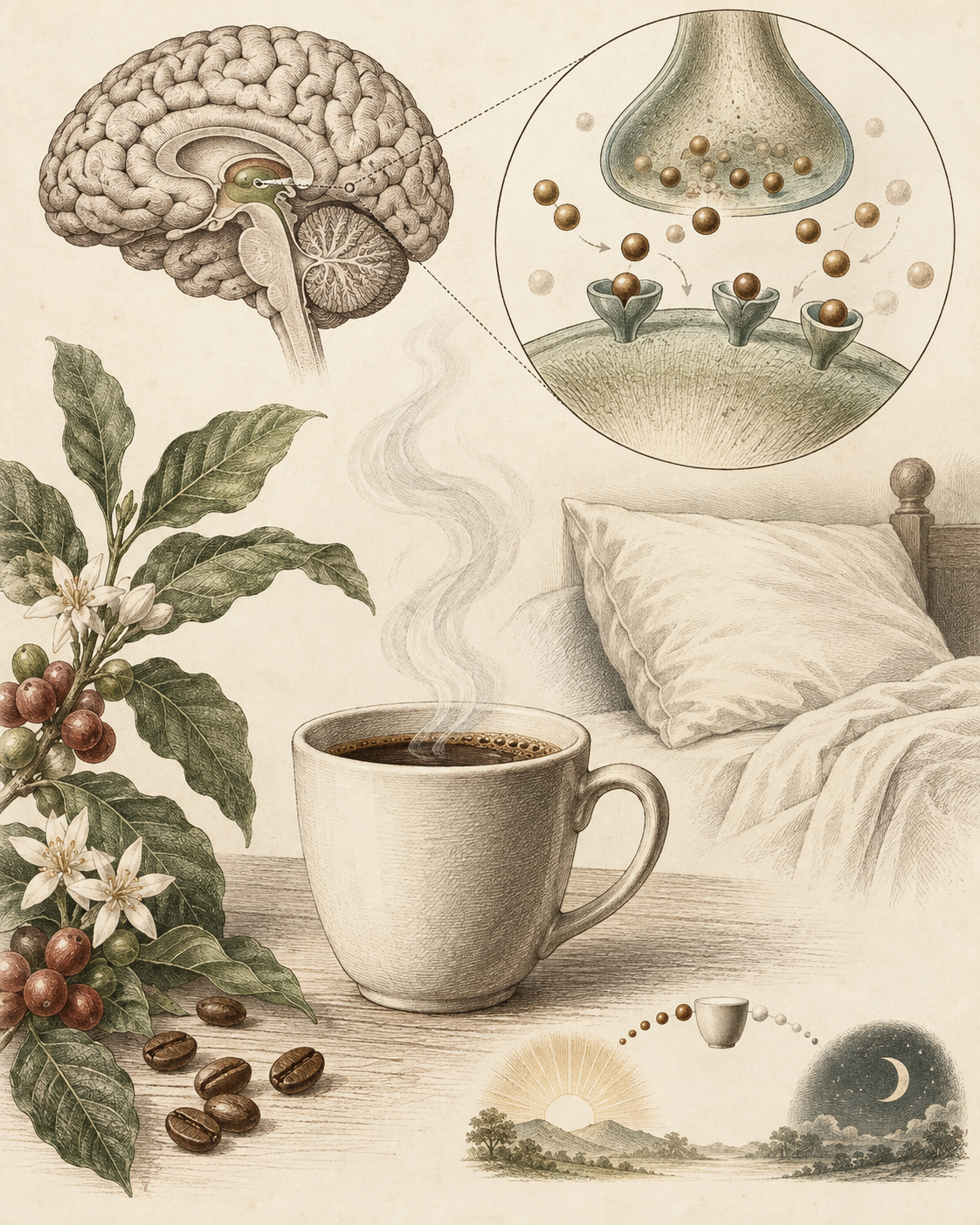
CAFFEINE BLOCKS A SLEEP-PRESSURE SIGNAL; IT DOES NOT CREATE REST
Caffeine primarily works by blocking adenosine receptors.
Adenosine is one of the signals associated with increasing sleep pressure across the day.
That can improve alertness for a while.
But caffeine does not erase the underlying need for sleep.
Its effects can also last for hours, and sensitivity differs a lot between people.
The useful question is not:
Is caffeine healthy?
It is:
Does the timing and amount fit the sleep and energy pattern I want?
WHY THIS MATTERS
Caffeine can remain active for hours, and bright, engaging or emotionally activating input late in the day can make winding down harder for some people. Sensitivity and timing vary individually.

A Note For You
Loading your personalized notes…

Recent Slip Insight
Add a Title
ONE BENEFIT TO WATCH FOR

Reducing Late-Day Stimulation Can Make the Transition Into Evening Less Abrupt
You may notice that the night feels less like slamming on the brakes when the final hours of the day are not stacked with caffeine and nonstop input.
This does not guarantee perfect sleep.
It simply gives your system a clearer descent instead of asking it to go from maximum engagement to lights out instantly.
WHY THIS MATTERS
Caffeine can remain active for hours, and bright, engaging or emotionally activating input late in the day can make winding down harder for some people. Sensitivity and timing vary individually.

WHAT PEOPLE DON'T TELL YOU
Observe before you overhaul.
Some people tolerate afternoon caffeine well.
Others feel it at bedtime.
Some can drink coffee and fall asleep but still wonder whether sleep quality changes.
Rather than copying someone else's rule, test your own pattern.
Timing.
Amount.
Reason.
Use data from your life before creating another prohibition.
THE BENEFIT OF DAY 104


“If you spend all day pressing the gas, do not be surprised when 'relax now' feels like a strange command.”
Cheers Without Beers

Your Version of Today's Experiment
Loading your personalized notes…

What to Take Away
Add a Title

Today's Experiment
Create a Stimulation Cutoff
Pick one form of late-day stimulation to reduce earlier than usual today and see what happens. Do not change everything at once.


Choose the Variable
Pick caffeine, notifications, background television, scrolling, work messages or another source you use heavily.


Move the Stop Earlier
Stop or reduce it earlier than usual by a realistic amount. This is an experiment, not a forever rule.

WHAT ARE YOU TESTING?
Does lowering one source of late-day stimulation change the way your evening feels enough to be worth repeating?


Notice the Descent
Pay attention to restlessness, boredom, sleepiness, irritability and how easy or difficult it feels to wind down.

One Afternoon and Evening

What to Watch For
Loading your personalized notes…
WANT TO GO DEEPER?
Caffeine Half-Life Without the Math Homework
A cup can be gone from the mug long before all of its effect is gone from your system.
Caffeine is metabolized gradually.
Its half-life is often measured in hours, not minutes, and varies with genetics, pregnancy, medications, smoking status and other factors.
That means an afternoon dose can still leave meaningful caffeine in the body later.
You do not need to calculate exact blood levels.
Use the concept to test timing.
If sleep, evening restlessness or needing more caffeine the next day is an issue, moving the final dose earlier can be a useful experiment.
Your response matters more than somebody else's perfect cutoff time.
Stop Pressing the Gas Automatically
Notice the total stimulation load.
Caffeine is one source of stimulation. Screens, noise and constant task-switching count too. Test reducing one source earlier today.


A Gentle Warning
Loading your personalized notes…
BEFORE YOU GO

What form of stimulation do you reach for fastest when your energy drops or a quiet moment appears?
Coffee, soda, phone, music, television, work, food, conversation, gaming or something else.

TODAY'S TAKEAWAY
Stimulation Is a Tool, Not a Default Setting
Use it when it helps. Notice when you are using it to avoid every dip, pause or quiet moment.

The Afternoon Crash
Tomorrow we put the pieces together and investigate the afternoon crash instead of automatically trying to overpower it.


bottom of page