.png)
What to Say to Your Kid about Drinking: A "Guide" from a Parent who Drank.

Updated: Oct 8
Story Time:
I started drinking early probably to some. Sophomore summer of high school was really fun. Junior year was willlld. By college, I was a pro. That also set the stage for a 25-year relationship with alcohol that was up and down, good and bad, fun and not fun- essentially… very gray.
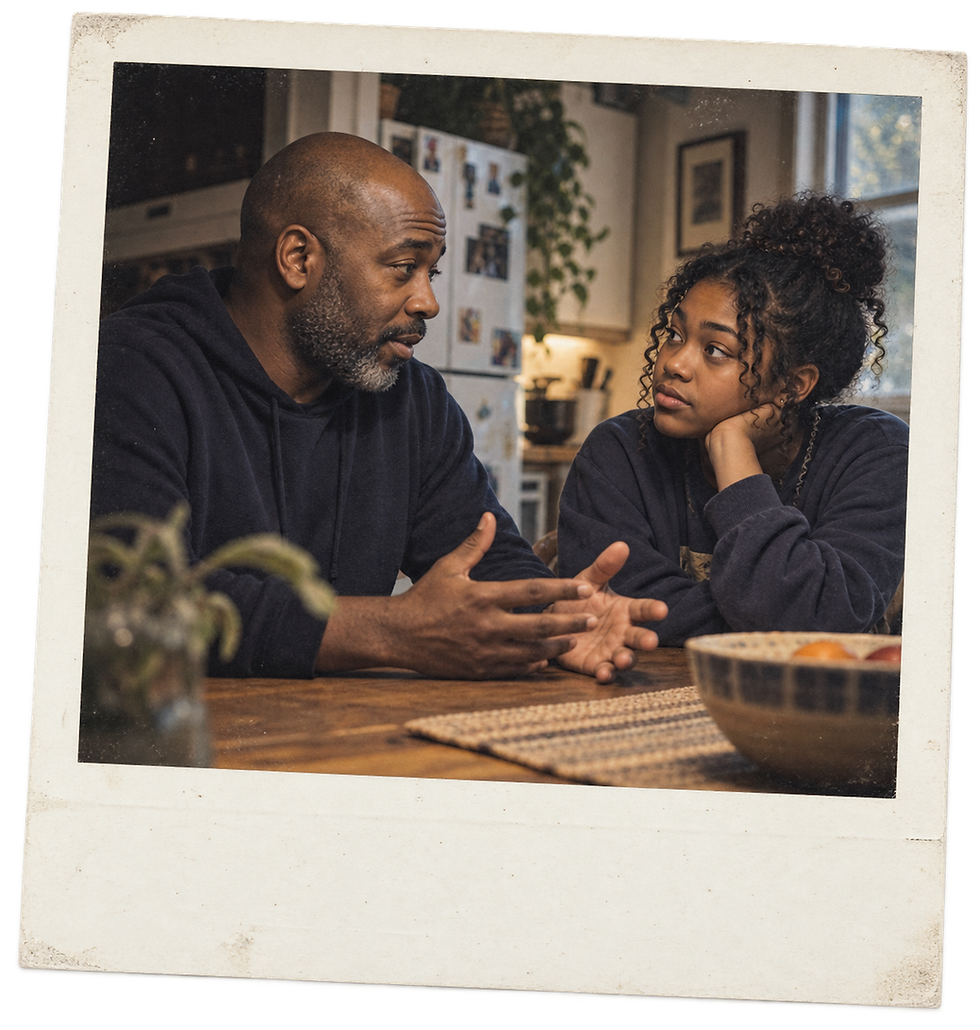
Now I’ve got 3 kids- in their formative years- and I have a boatload of perspective and knowledge about booze. What do I say to my kids about drinking? I don’t have all the answers (this parenting thing can be tricky), but I try to look back at my young self, absorb the information I've gained, and examine it all and try to apply it in good faith.
Of course, I had a choice to start drinking alcohol. It’s absurd to think we don’t have a choice. I am huge believer of free will, of extreme ownership- and the ability to shape our fate. These are some of my core values- I honor the hell out of these ideas. Truly.
I want to say though, if you don’t think the cards are stacked in the house’s favor when it comes to early drinking, you’re simply not thinking enough or don’t have the awareness (I didn’t either- for a very long time- that’s ok)
If you look at when most people start drinking- like I did when I was a young teen- you’ll notice a few things biologically and socially. You'll also see some patterns in our culture, and how our own behaviors as parents are still influential.
From a biological perspective, the emotional/reward part of our brain- the limbic system- has already developed-it’s cooking.
The prefrontal cortex- the piece that controls logic and planning and risk- develops fully later- later than you expect (think mid 20’s!). It’s still being built- it’s pruning itself, figuring out how to operate.
That’s why you see in teenagers some really smart decisions one minute, and stupid, idiotic, “what the hell were you even thinking” ones the next.
That’s not a cop out, that’s a biological reality.
So, the immediate reward, novelty, excitement… dominates.
The young brain is making fast choices and not thinking of “oh, shit, what will this do to me long term, or even in the next hour.”
And it’s fully not capable of doing that at a complete level yet.
Again, not an excuse- the reality.
2.) “If Johnny jumped off a bridge, would you do it?” Probably.
Mix in how so very important peers are in those years...and oh, boy.
Hang on tight.
This is huge.
That young person is shifting from their parents (or their constant life figures) as the main reference point in their lives, to "their bro’s", "their click", their friends... it’s a built-in feature that is truly amazing.
It’s driving them to be independent- to fly out of the nest- as we are designed to and should. It’s-as Peal Jam says- “Evolution babbbbby!”.
We’re wired this way at a deep level.
You get a laugh from a friend, you get acceptance... invited to the dance- dopamine spikes. Friends don’t invite you to a party, left on read.... crushed & confused.
Does this mean parents have no influence? Of course, not…(see point 5). Parents are still extremely important in this phase- they are the baseline, the foundation.
But they are already expected. Our influence is still there, but it has changed forms.
The instant feedback loop of peers defines their identity- it is a mirror, and they are chasing that mirror to figure out who the hell they really are and whom they want to become.
3.) Fertilizing a Lawn That Can’t Absorb Fertilization.
You are taking a substance that reduces inhibition in a brain that hasn’t fully developed its full capacity of inhibition.
Think about that.
Think of a toddler learning to walk… alcohol is basically your foot tripping them every time they take a step. The body simply isn’t ready yet.
(If you say that exact line to your teenager...good luck. You are disrespecting their forming identity, and you shouldn’t- regardless of our knowledge and regardless of how the analogy stands true. Honoring who someone is becoming- warts and all- is one of the most beautiful pieces of parenting)
4). “Do you think Doing Alcohol Is Cool”- Michael Scott, The Office.
Sprinkle on our society’s romanticizing of this drug, and it’s a recipe for habit forming- of an automatic response that is a built-in feature before you even recognize it. It’s not only the billions of $$$ spent on the identification and what the drink represents. It’s not only that it is marketed not as a substance, but as a solution- to stress, to celebration, to the tribe…
But...
It’s also the baseline of our communities, the stories we tell, the ultimate transitional signal from youth to adulthood.
These rituals- these signals- these transition markers, are becoming few and far between in this day and age (for another article) and alcohol stands as a beacon of transformation from youngster to adult (though there is a shift happening here-also, another article).
5.) What We Do Now Matters.
If you still drink, your kids feel it.
They see it.
They copy it.
Even if we aren't the complete influencer anymore, we still model.
They know when your irritable after you drink. They feel you not being present the next day after drinking.
But they also see you laughing too loud with friends and drinking at certain events and times- subconsciously they are sucking this in as a symbol of adulthood. Of growing up. Of "just what you do".
This matters.
Actions always speak louder than words. "Do as I say- not as a I do" is the most illogical, asinine idiom our collective humanity has ever uttered. Lead by example. Consider taking a short break, at the very least. See how it makes you feel.
I promise... not only will it be an amazing example, but you will feel really, really, good.
Side note: The notion of "Well, I did it when I was their age, and I turned out ok. They'll be fine"... is, to put it bluntly, lazy. This author shared that belief as a drinker for many years (projecting in advance how I would tackle this topic), so I'm allowed to call it what it is.
Final Thought.
So… what would I say? I would be honest about my experience. I would lead by example. I would be informed. I would respect that they are an individual- forming their own self- and understand that our deep desire to protect can come across as controlling if not communicated properly.
Our goal as parents should not be to make decisions for our kids. We probably can't do that anyway, and if we do, resentment will be formed, or maybe even worse, full expressions of an individual is tainted.
Neither is good.
Our goal should be to raise enough awareness (through steady conversation, not preaching) to analogize decision making in a way that makes sense, and be an anchor for how people that don’t drink can actually be.
Your kids aren’t naïve, don’t treat them that way.
Talk to them like humans, do what is in your control, and ultimately, accept the choices they are going to make-even if you don’t agree.…
Oh, and love them like hell through every single one of those choices-good, bad, and ugly.
We only get one go around at this, and love is a pretty powerful guide.


Comments