.png)
How Much Alcohol Is Too Much? The Line Most People Don’t Notice

Updated: Oct 8
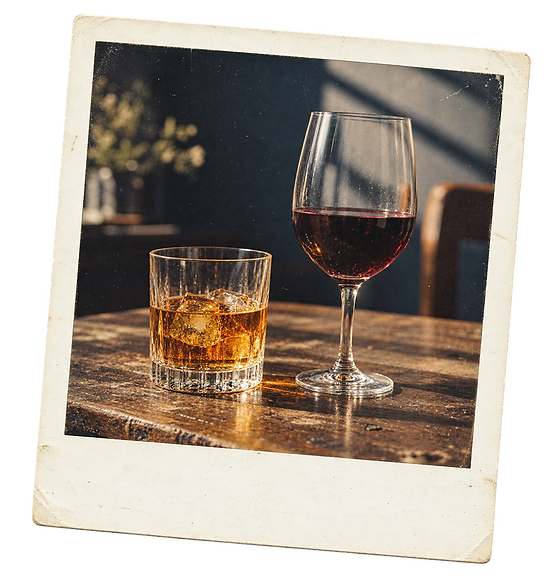
Most people don’t ask themselves a dramatic question like:
“Am I addicted to alcohol?”
Instead, the question is usually quieter.
How much alcohol is too much?
The reason the question is hard to answer is that alcohol problems rarely appear suddenly. For many people, drinking gradually becomes part of daily routine — something that simply happens at the end of the day.
Work ends. Dinner starts. A drink appears.
Nothing seems obviously wrong.
But over time, some people begin noticing small changes:
sleep feels lighter
energy feels less consistent
anxiety feels stronger in the morning
drinking feels automatic
These patterns are often part of what researchers and clinicians call gray area drinking, which we explore further in Gray Area Drinking: What If It’s Not Black and White?
Gray area drinking refers to alcohol habits that fall somewhere between occasional social drinking and alcohol dependence.
What Health Guidelines Say
Public health organizations provide general guidelines for alcohol consumption.
According to the Centers for Disease Control and Prevention, moderate drinking is typically defined as:
Women:Up to 1 drink per day
Men:Up to 2 drinks per day
Heavy drinking is generally defined as:
Women:8 or more drinks per week
Men1:5 or more drinks per week
These numbers are based on research linking alcohol consumption with long-term health risks.
But numbers alone don’t always capture how alcohol affects someone’s daily life.
Many people fall below these limits but still notice subtle patterns connected to alcohol.
The Signs Alcohol May Be Affecting You
For many people, the question “how much alcohol is too much” becomes relevant when certain patterns start appearing.
These patterns often include:
Sleep changes
Alcohol can make people fall asleep faster but often disrupts deeper sleep stages later in the night.
Our article Alcohol and Sleep: Why Drinking Feels Like It Helps — But Often Makes Sleep Worse explains how alcohol interferes with REM sleep cycles.
Poor sleep can ripple into the next day in subtle ways.
Energy fluctuations
Alcohol also affects hydration, blood sugar, and metabolism.
These effects can lead to:
afternoon fatigue
lower motivation
brain fog
We explore this connection further in Why Is My Energy So Low? Could Alcohol Play a Role?
Anxiety patterns
Alcohol initially reduces anxiety by increasing calming neurotransmitters in the brain.
But later — often the next morning — the brain compensates by increasing stress chemicals.
This rebound effect can contribute to morning anxiety or irritability.
For a deeper explanation, see Anxiety and Alcohol: Why Drinking Feels Like Relief (But Makes It Worse).
When Drinking Becomes a Habit
Another important factor is how alcohol fits into routines.
Many people discover that their drinking isn’t driven by strong cravings.
It’s driven by timing.
For example:
6:30 p.m. arrives. Dinner begins.A drink appears.
This pattern is explained in Why Do I Crave Alcohol at Night? (The Brain Science Behind Evening Drinking).
The brain learns associations between time, environment, and behaviors.
When alcohol becomes part of a predictable routine, the brain begins expecting it automatically.
The Question Many People Eventually Ask
Because alcohol habits often develop gradually, many people don’t experience a dramatic turning point.
Instead, the question appears quietly:
What would happen if I stopped drinking for a while?
Not forever.
Just long enough to observe what changes.
For people who are curious about experimenting with a short break, our article Thinking About Taking a Break From Alcohol? explains how many people approach this type of experiment.
A Simple Way to Find Out
For many people, the clearest answer to “how much alcohol is too much” doesn’t come from a number.
It comes from observation.
Some people try a short experiment such as:
thirty days without alcohol
During that time, they pay attention to:
sleep quality
morning mood
energy levels
evening routines
If you’re curious what changes people often notice early in that process, see What Happens When You Stop Drinking? The First 14 Days (Alcohol Timeline).
You Don’t Need Rock Bottom to Ask
One of the biggest misconceptions about alcohol is that people only reconsider their habits after serious consequences.
In reality, many people simply become curious about their routine.
They notice patterns.
They ask questions.
They experiment.
And sometimes those small observations lead to meaningful improvements in sleep, energy, and daily structure.
The Bottom Line
So how much alcohol is too much?
For some people, the answer is defined by health guidelines.
For others, the answer appears through patterns:
disrupted sleep
increased anxiety
lower energy
automatic evening drinking
The important thing is that asking the question itself is often the first step toward understanding your relationship with alcohol.
And sometimes the most revealing way to answer that question is simply to pause the routine and see what changes.
#POSITIVE INFINITY
Final note:
If you’ve been questioning your habits, it’s worth taking a closer look at Am I Drinking Too Much- 7 Signs Your Drinking May Be More Habits Than Choice because this pattern often starts subtly before it becomes consistent.
It also tends to connect to Why You Crave Alcohol at Night, especially when the urge shows up at the same time each evening.
Explore the CWOB Drinking Pattern Snapshot to discover a detailed understanding of the roots of your drinking habits.


Comments